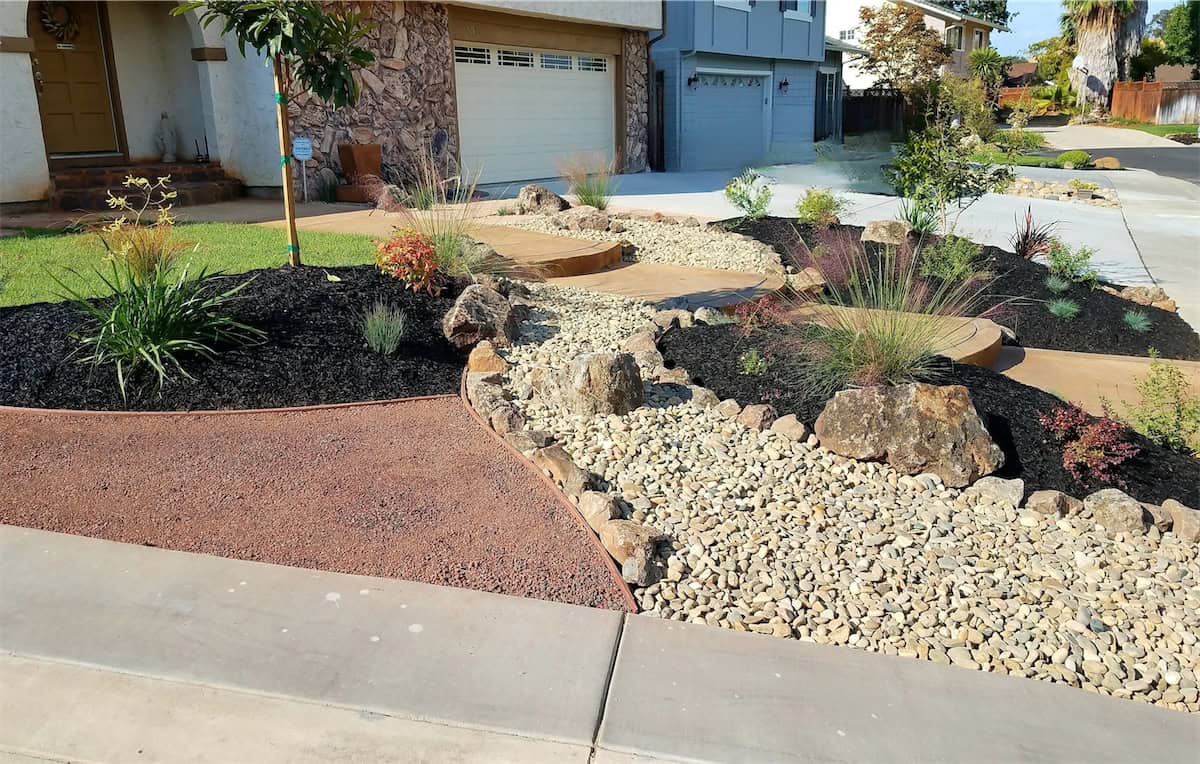
A dry creek bed is a shallow, rock-lined channel that guides rainwater across a yard and still looks good on dry days. After a storm, it carries runoff along a path the homeowner chose. In midsummer, it reads as a streambed of smooth stones winding past the plantings.
Width, rock size, and the plants along its banks decide much of its charm, and each detail is easy to tune for a particular lot. Twenty-nine favorite versions follow, each with one practical detail worth copying.
Table of Contents
- Dry Creek Bed Ideas for Every Kind of Yard
- Dry Creek That Empties Into a Rain Garden
- Mexican Beach Pebble Strip With Steel Edging
- White River Rock Curve Through a Fenced Side Yard
- Low Path Lights Along the Creek Banks
- Concrete Stepping Pads Over a Black Pebble Bed
- Japanese-Style Dry Creek Down a Garden Slope
- Bluestone Slab Bridge Over a Narrow Channel
- Desert Dry Wash With Standing Stones
- Woodland Creek With Ferns and Hostas
- Gravel Channel Over a French Drain
- Stacked Stone Banks on a Curving Lawn Edge
- Stepped Boulder Spillway on a Slope
- Two-Tone Gravel With a Rounded Stone Border
- Rocky Runnel Carrying Downspout Water Away
- Boulder Accents Along a River Rock Bend
- Wooden Footbridge Over a Backyard Creek
- Ornamental Grasses Softening the Banks
- Prairie Wildflowers Lining a Front Yard Creek
- Rust-Toned Boulder in a Wide Bend
- Narrow Rock Swale Beside a Paver Path
- Dry Creek Bed Along the Driveway Edge
- Cottage Creek Edged With Flowering Heather
- Xeriscape Creek With Agave and Barrel Cactus
- Large Cobble Splash Bed Against the Foundation
- Strappy Perennials Along a River Rock Creek
- Modern Linear Creek With Corten Steel Edging
- Wide Boulder-Lined Creek Across an Open Lawn
- Creeping Thyme Between the Edging Stones
- Stone-Lined Channel Through a Shady Lawn
- How to Plan a Dry Creek Bed That Actually Moves Water
- Dry Creek Bed FAQs
Dry Creek Bed Ideas for Every Kind of Yard
Every idea below pairs a drainage job with one specific design choice, whether that means stone size, edging or the plants along the banks. Most of them scale up or down to fit almost any lot.
Dry Creek That Empties Into a Rain Garden
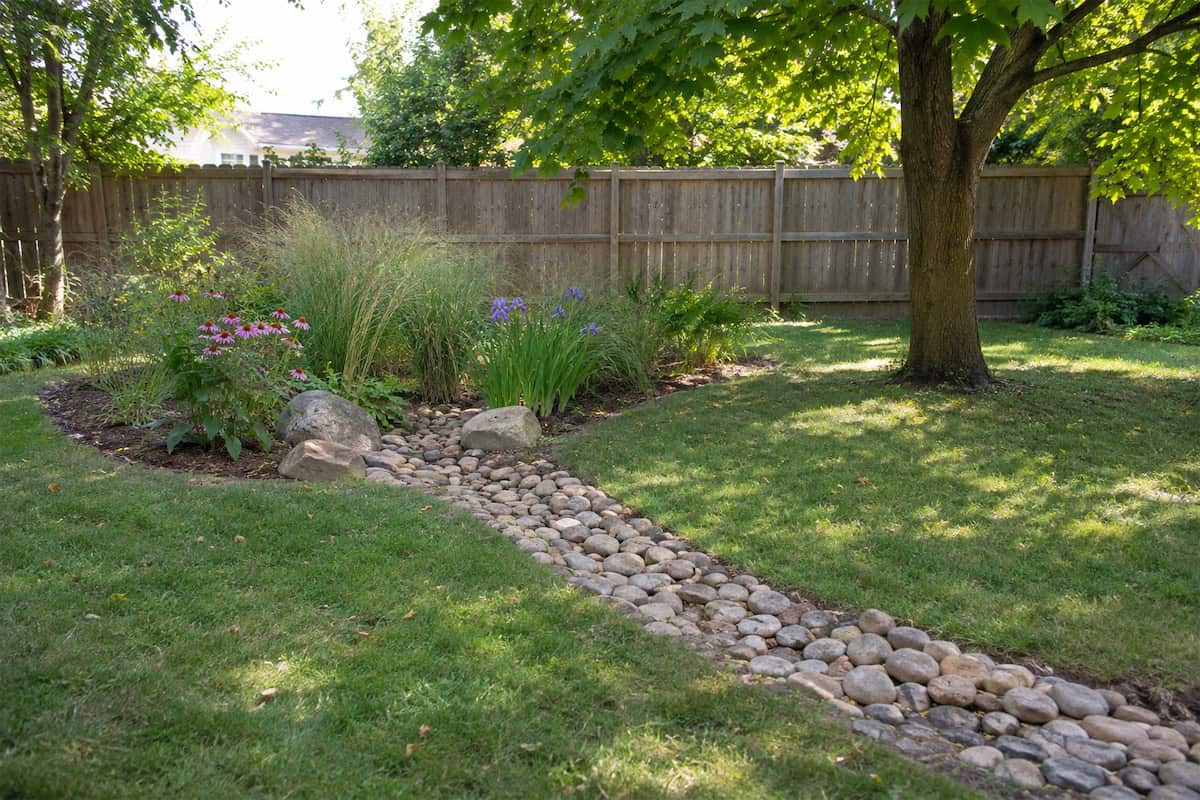
A planted basin at the end of the channel keeps stormwater on the property and lets it soak in slowly. The rain garden becomes the outlet, and the creek is its delivery line.
Size the basin as a shallow, saucer-shaped depression, a few inches lower than the creek’s final stretch. Place a wide apron of larger river rock where the channel meets the basin to slow the water before it reaches the plants, then fill the bowl with moisture-tolerant natives.
Mexican Beach Pebble Strip With Steel Edging
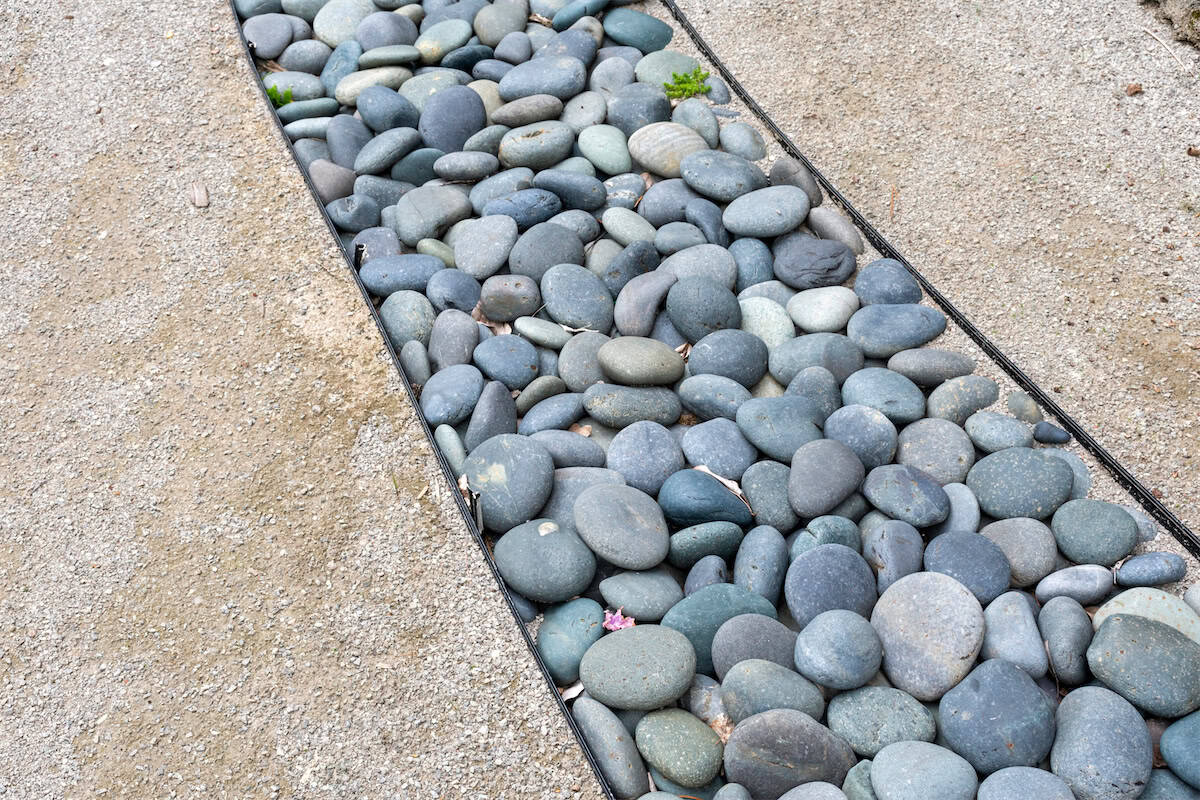
Smooth, charcoal-gray Mexican beach pebbles look tailored and modern, especially in a straight strip beside a walkway or patio. Steel edging keeps the line crisp and holds the pebbles in place.
Install the edging first, setting the top about half an inch above the finished pebble level. Because these pebbles cost more than standard river rock, fill the lower part of the channel with cheaper gravel and save the pebbles for a single top layer.
White River Rock Curve Through a Fenced Side Yard
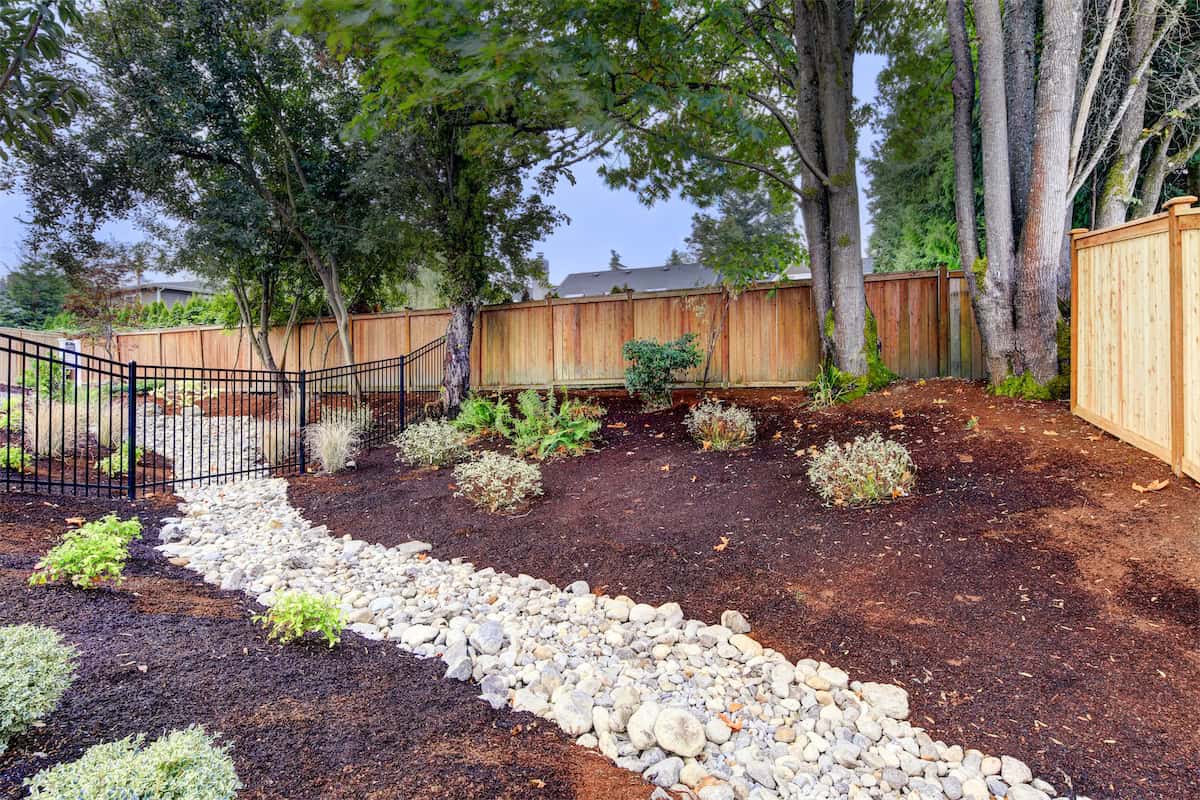
Light stone brightens narrow, shaded side yards. A single gentle curve of white river rock leads the eye toward the back gate and handles runoff funneled between two houses.
Keep the curve wide; a tight S-bend in a 6-foot side yard looks forced. Check that the channel drains toward the street or a rain garden on the homeowner’s own lot, and direct no runoff onto the neighbor’s side of the fence.
Low Path Lights Along the Creek Banks
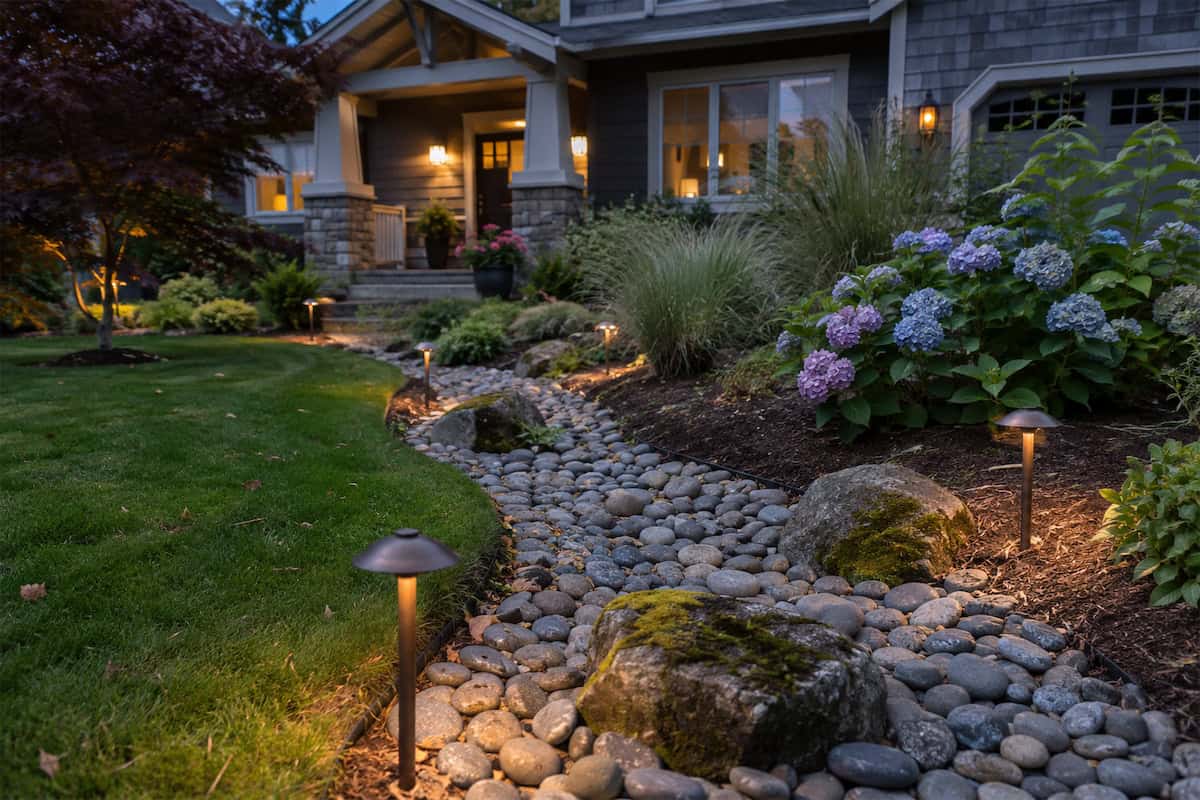
A low light grazing across wet stone shows off the shapes of the rocks at night. Low-voltage or solar path lights placed along one bank do the job without glare.
Stake fixtures on the high ground behind the bank stones, never inside the channel where water flows. Stagger them every 6 to 8 feet on alternating sides for a natural look, and aim them down and across the rock to catch the edges of the boulders.
Concrete Stepping Pads Over a Black Pebble Bed
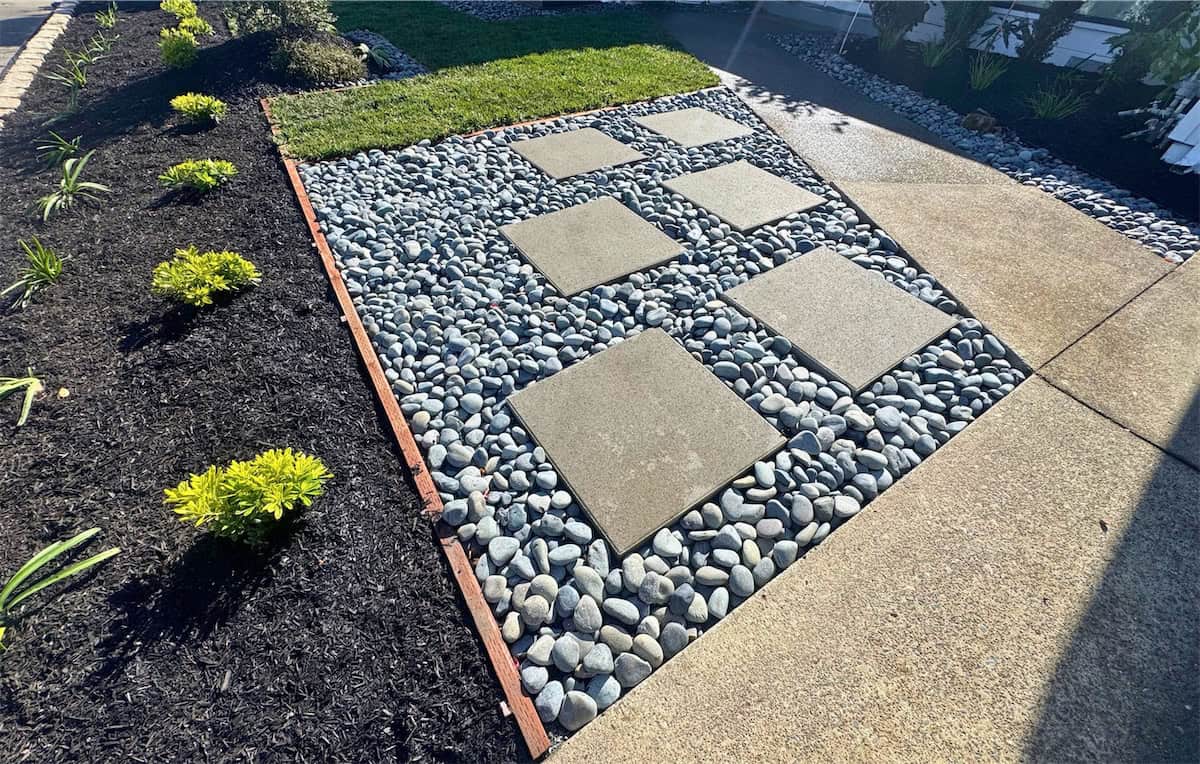
Square concrete pads floating over black pebbles look sharp and graphic. They let foot traffic cross the drainage channel without disturbing it, and precast 16- or 24-inch pads are easy to find at home centers.
Set each pad on a compacted gravel base so it sits flat and slightly above the pebble surface. Space them about 24 inches apart, center to center, for a comfortable stride, and leave the gaps open so water travels freely underneath.
Japanese-Style Dry Creek Down a Garden Slope
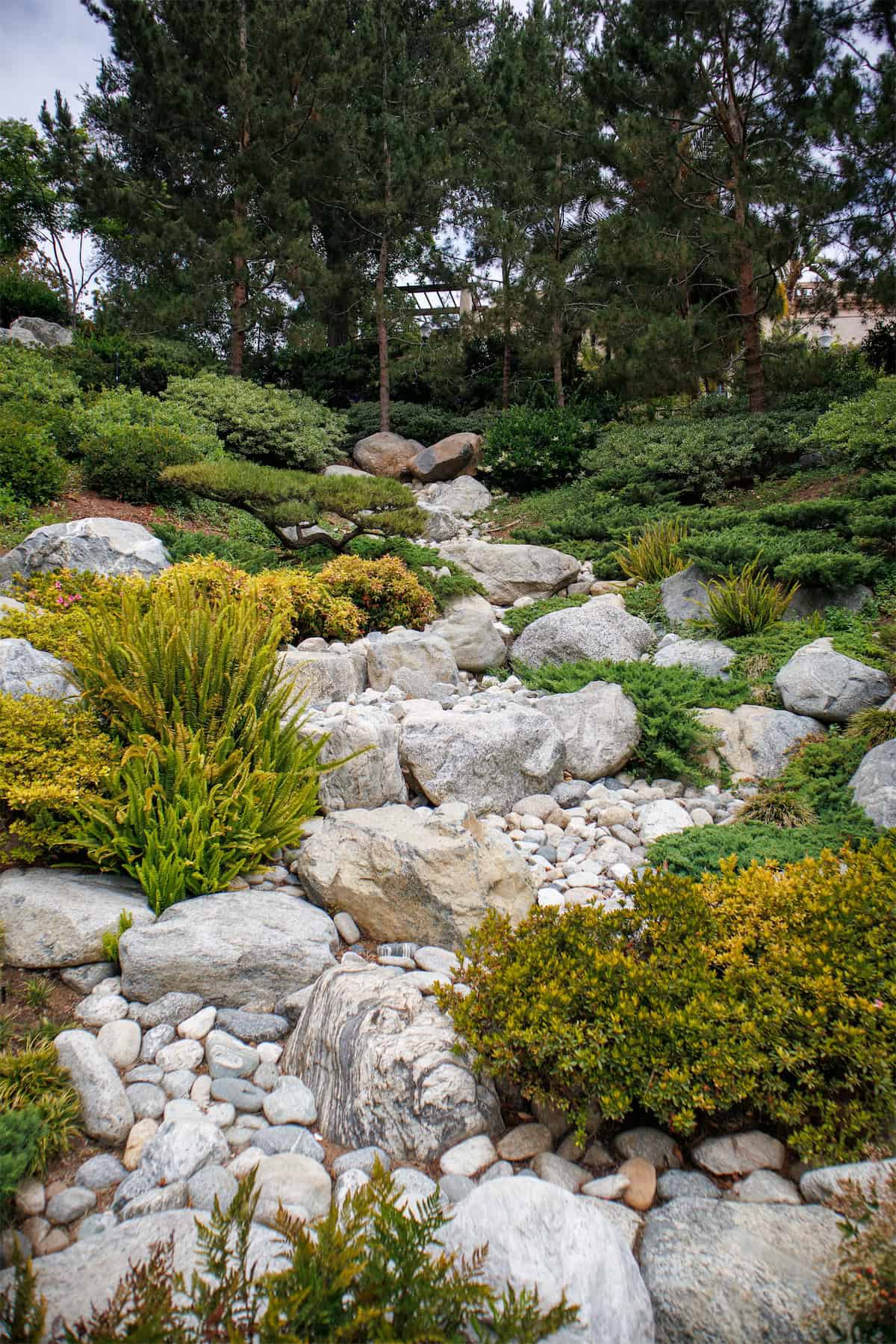
Fewer, larger stones, carefully chosen and placed, define this restrained style. Down a slope, the creek suggests a mountain stream and handles runoff headed downhill.
Select one or two dominant boulders for the top of the run and let stone size decrease toward the bottom. Rake the smaller gravel lightly in the flat sections. Plant sparingly, with Japanese forest grass, a dwarf maple or moss on the shaded banks.
Bluestone Slab Bridge Over a Narrow Channel
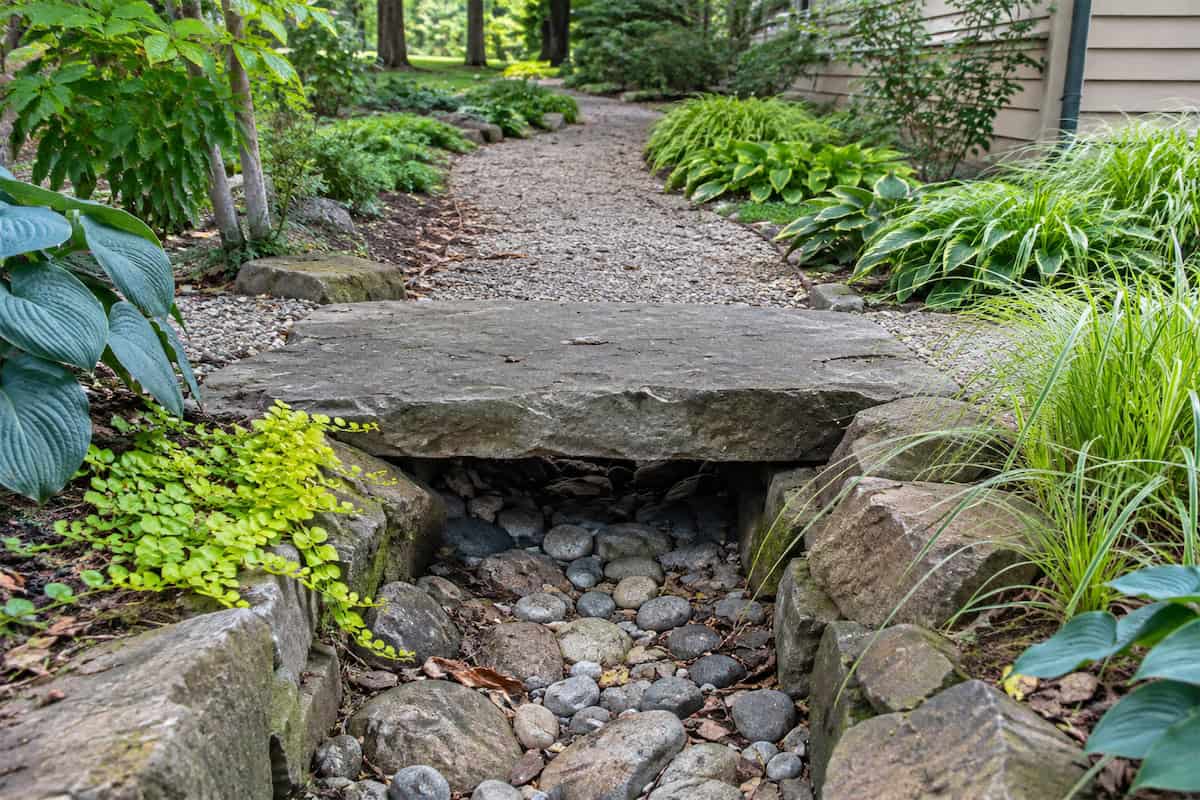
A single slab of bluestone across a narrow creek looks ancient and requires no carpentry. It fits best over channels under about 3 feet wide.
Choose a slab at least 2 inches thick, and let it overlap each bank by 8 to 12 inches. Bed the ends on compacted gravel or a flat base stone so the slab doesn’t rock. A natural cleft surface grips better in wet weather than a honed finish.
Desert Dry Wash With Standing Stones
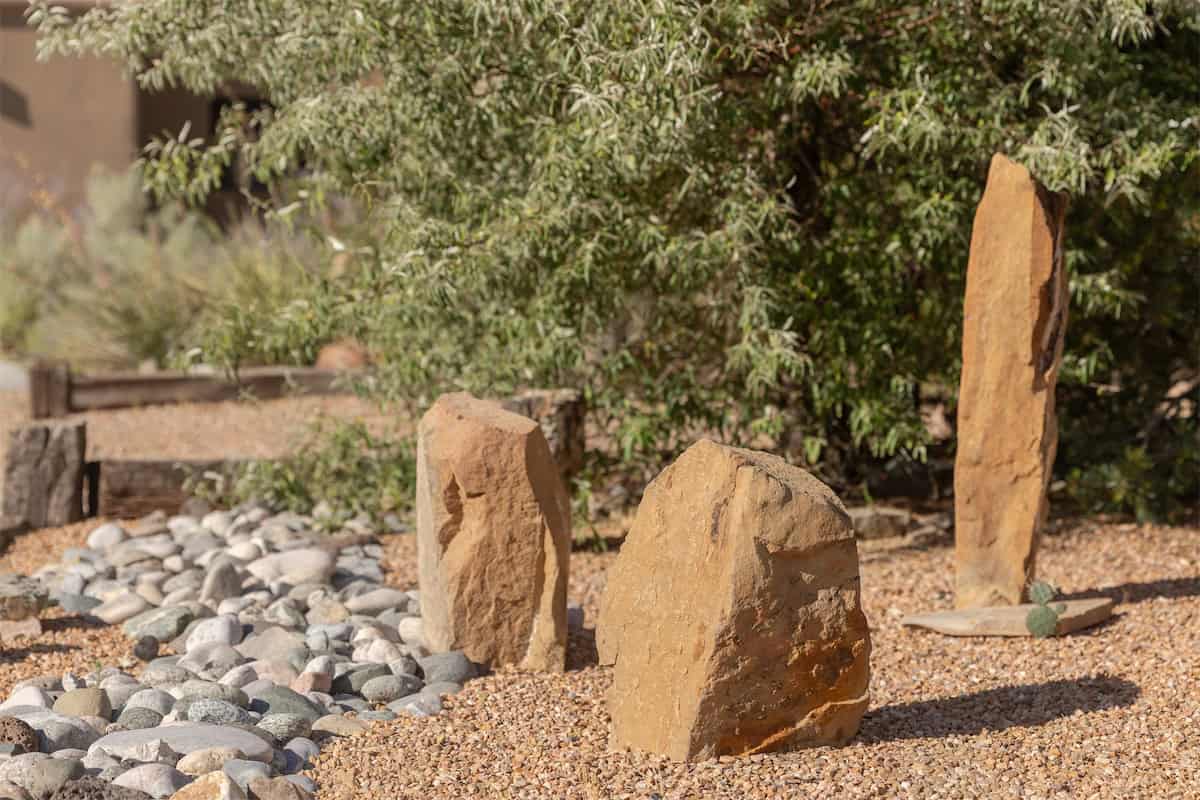
An arroyo-style wash looks at home in the arid Southwest and handles sudden monsoon downpours. Tan or rust-colored decomposed granite and angular rock match the native landscape.
Set a few tall, narrow stones upright along the banks, burying a third of each for stability. These standing stones read as sculpture against the flat wash. Plant sparse desert natives such as brittlebush or desert marigold well above the flow line.
Woodland Creek With Ferns and Hostas
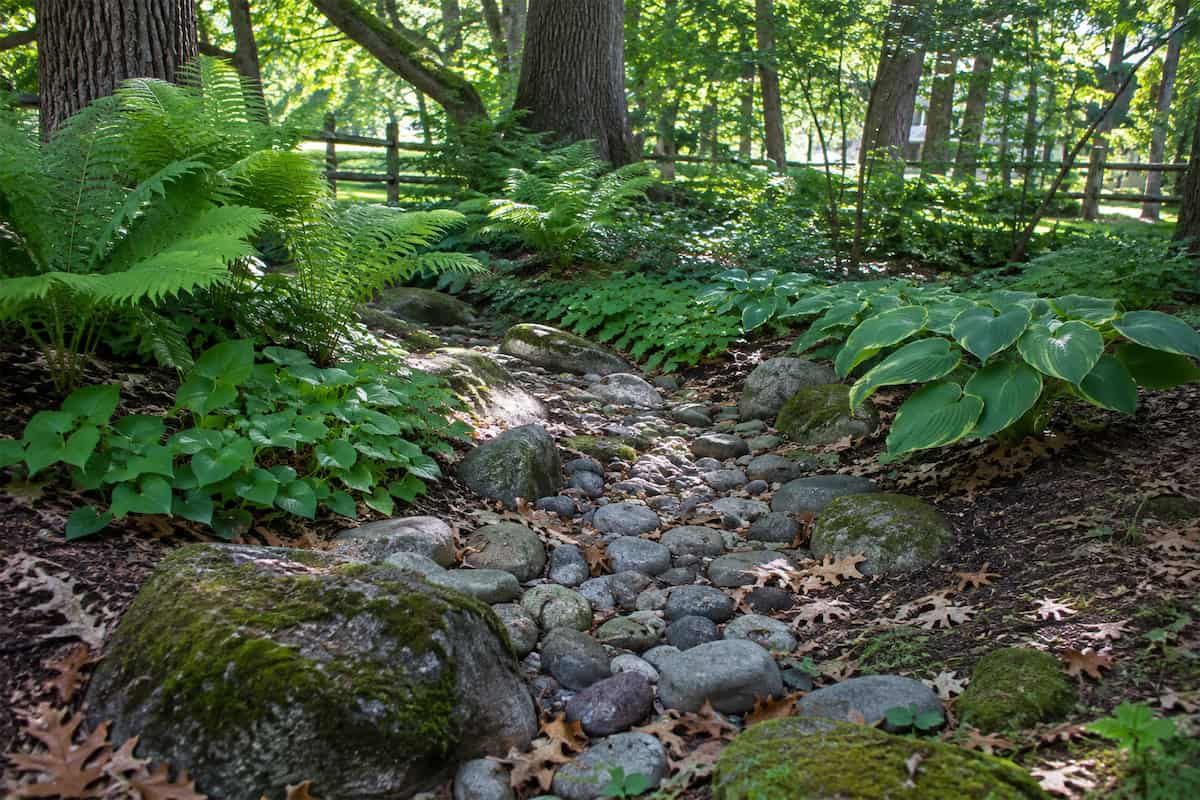
Mossy rock and soft foliage look natural under a tree canopy, while the channel carries away water that drips through the leaves. Ferns and hostas both handle shade and occasional soaking.
Use weathered or lichen-covered stone if available; it ages in faster. Plant ferns such as ostrich or Christmas fern on the banks, with hostas set back in pockets above the high-water line. Leave fallen leaves on the planted banks but clear them from the channel each fall.
Gravel Channel Over a French Drain
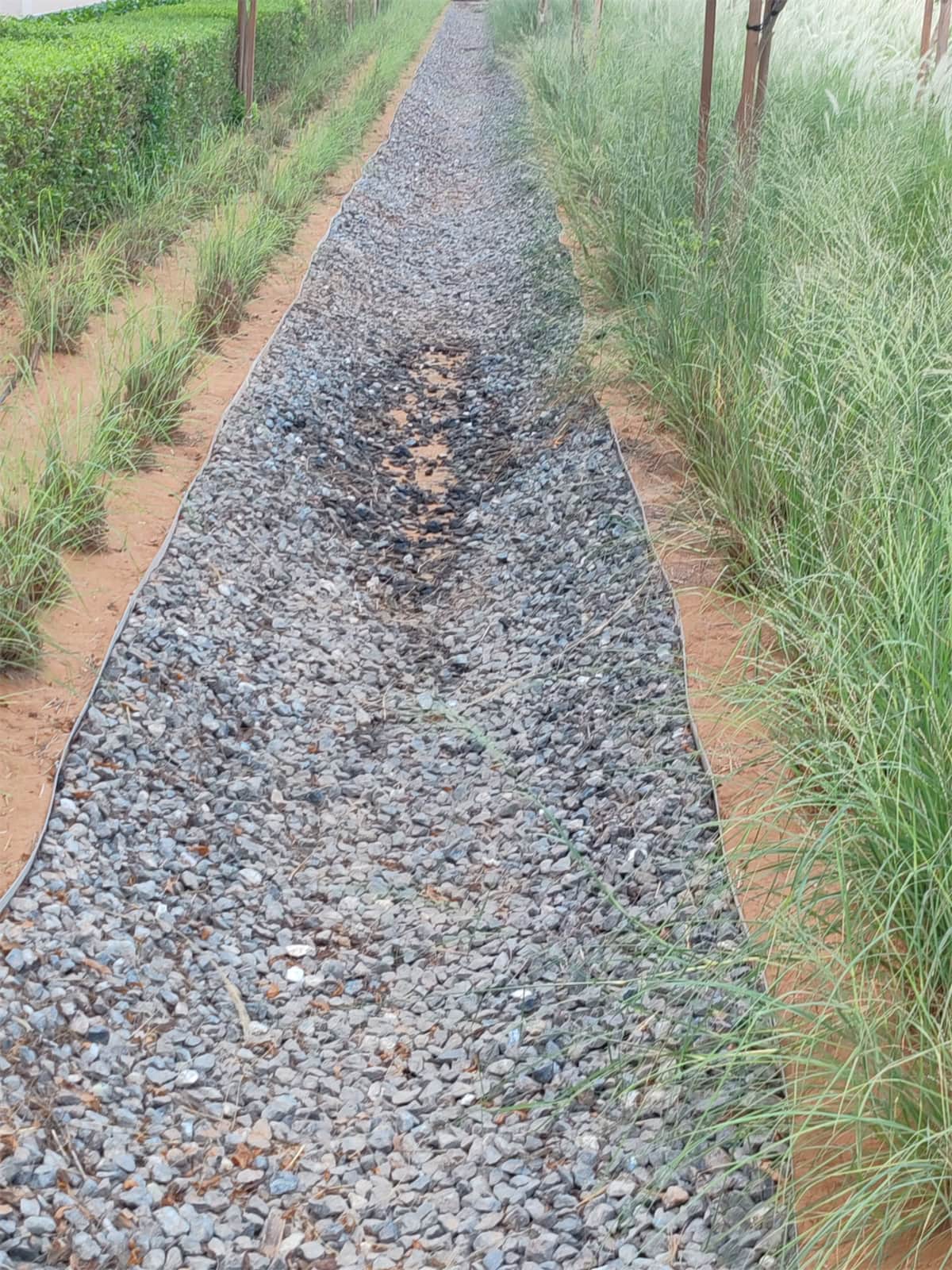
A French drain paired with a surface creek handles both groundwater and runoff. The perforated pipe below collects water that soaks in, and the rock channel above handles surface flow.
Dig the trench, lay the perforated pipe in washed gravel wrapped in filter fabric, and slope it toward a daylight outlet. Then shape the shallow creek bed on top. The surface rock hides access to the pipe and keeps the line visible for future maintenance.
Stacked Stone Banks on a Curving Lawn Edge
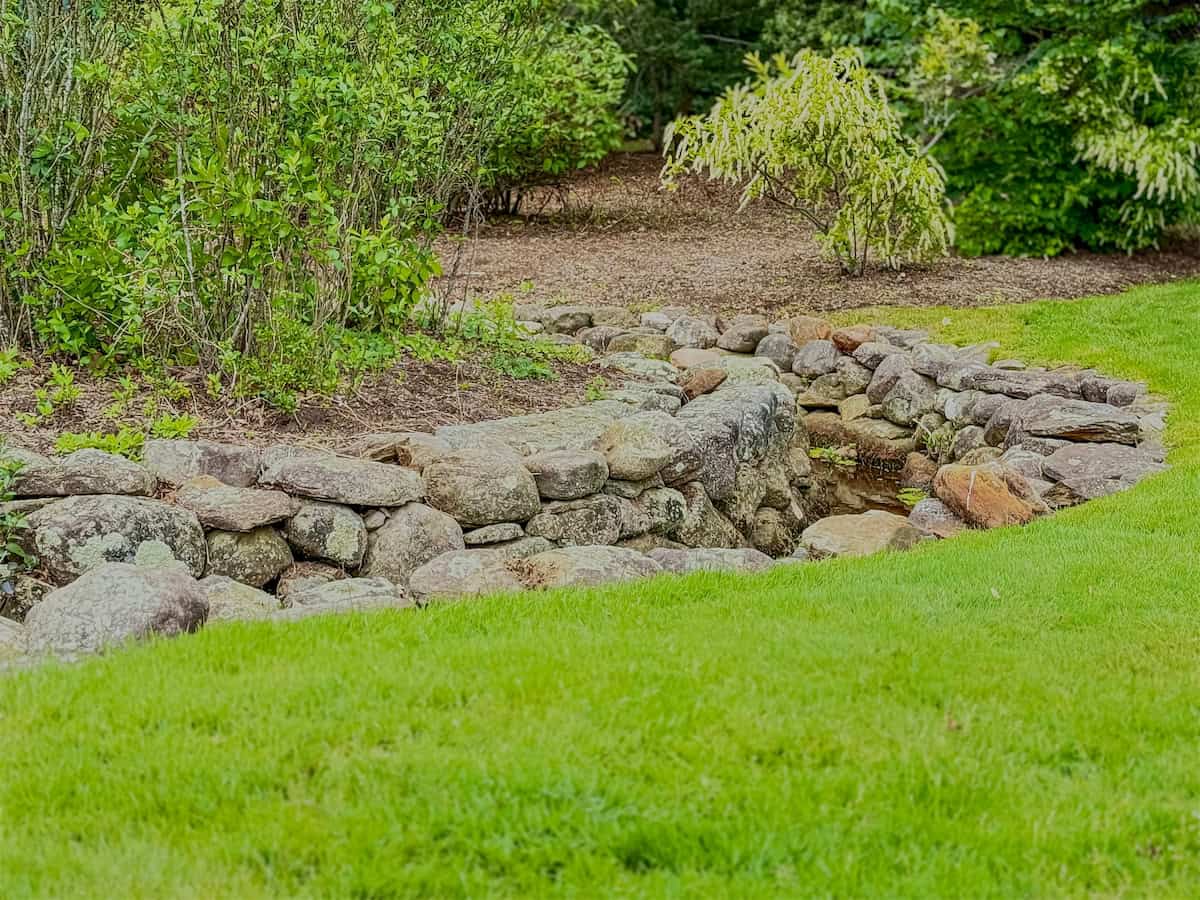
Where a creek runs along a raised lawn, stacked flat stone holds the bank vertical and keeps turf from sliding into the channel. Flagstone or fieldstone stacked in courses looks tidy and handles the job.
Lean each course slightly back into the soil, about an inch per foot of height, and stagger the joints like brickwork. Keep dry-laid banks low, around knee height, so they hold without mortar. Follow the curve with smooth, wide arcs.
Stepped Boulder Spillway on a Slope
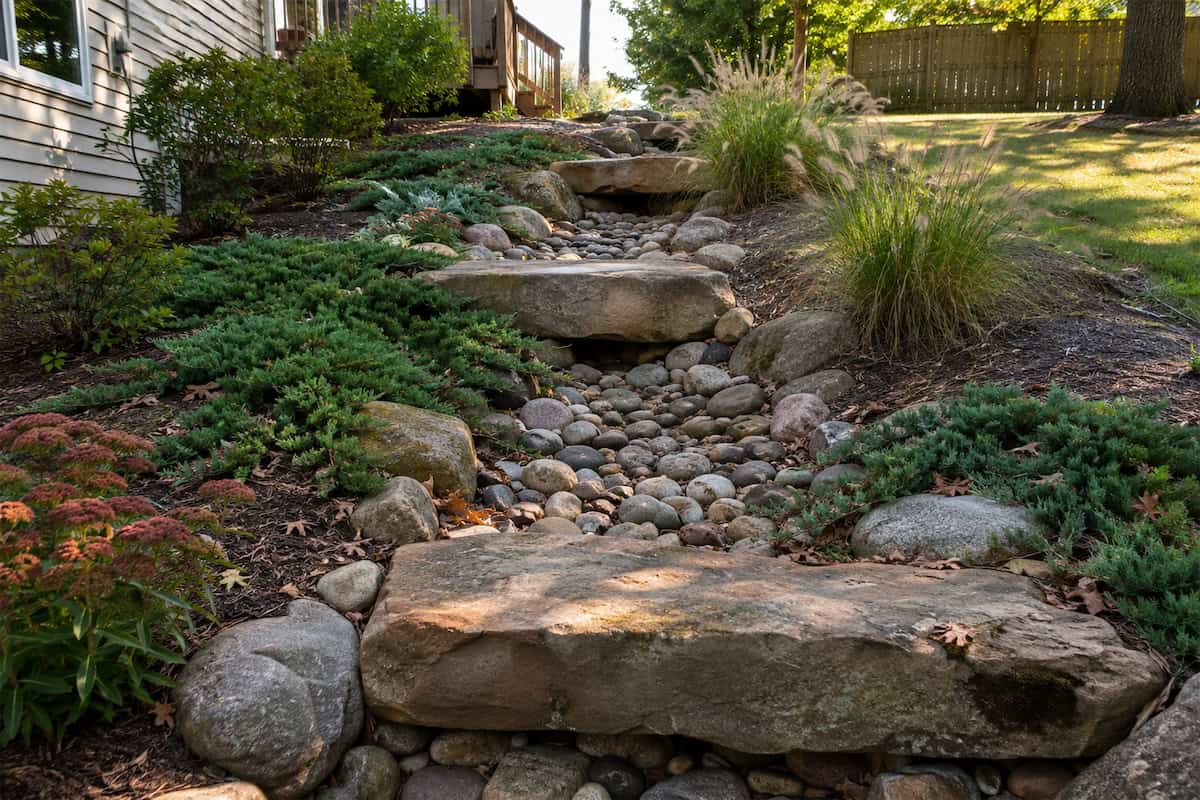
On a steeper slope, water picks up speed and erodes a plain channel. A series of boulder steps slows it down, with small pools of rock between each drop.
Set the boulders across the channel in short, level ledges, each one dropping 6 to 12 inches. Pack river rock behind and below each ledge to absorb the splash. The stepped look resembles a mountain cascade and protects the slope during the heaviest storms.
Two-Tone Gravel With a Rounded Stone Border
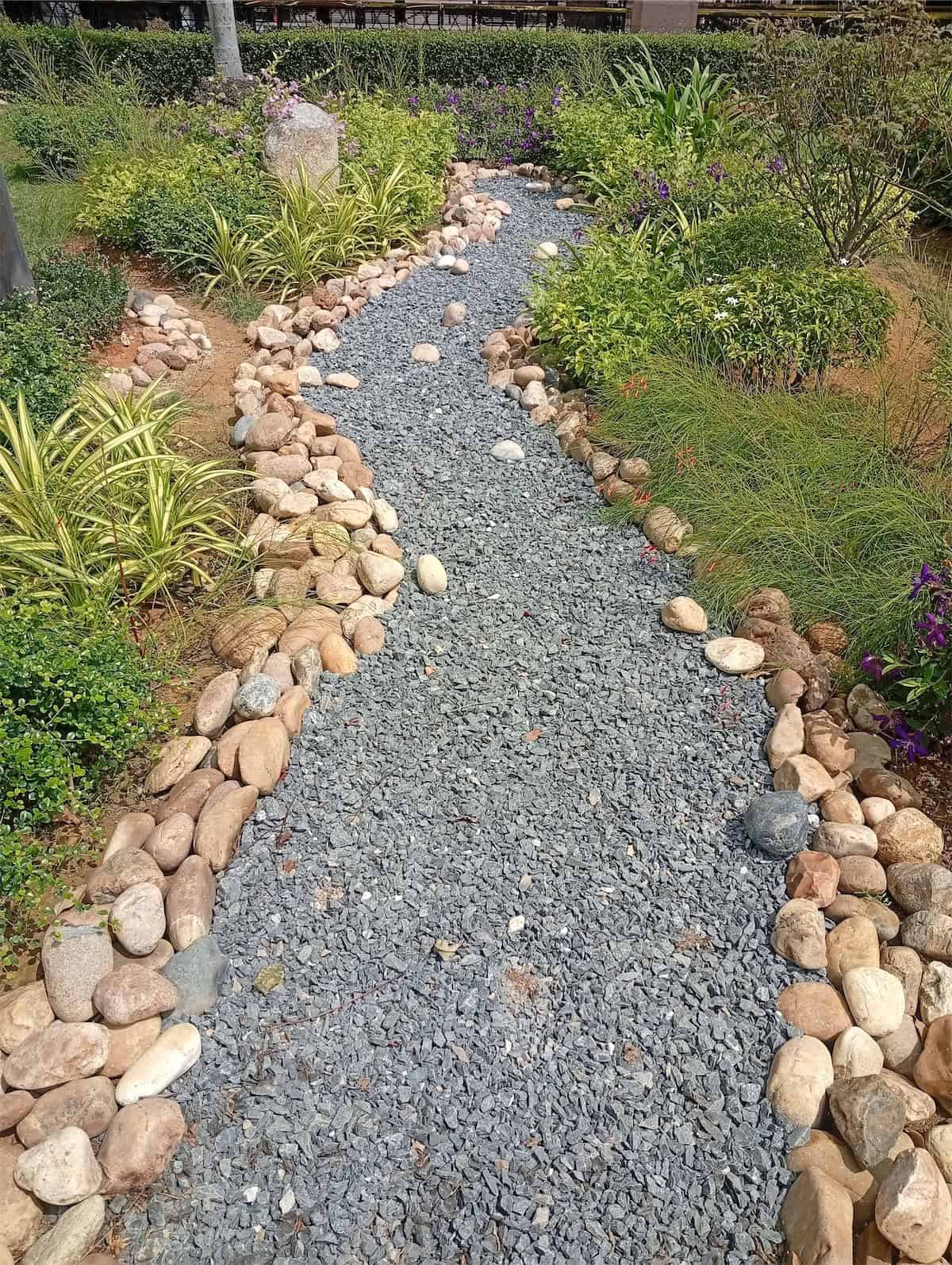
Contrasting gravel colors define a creek in modern or minimalist yards. Light gravel in the center with a darker rounded stone border, or the reverse, outlines the channel clearly.
Use a fine, 3/8-inch gravel down the middle and larger 2- to 4-inch rounded stones along the edges. The larger border stones resist washing out during storms. A steel or plastic edge buried between the two keeps the colors from mixing over time.
Rocky Runnel Carrying Downspout Water Away
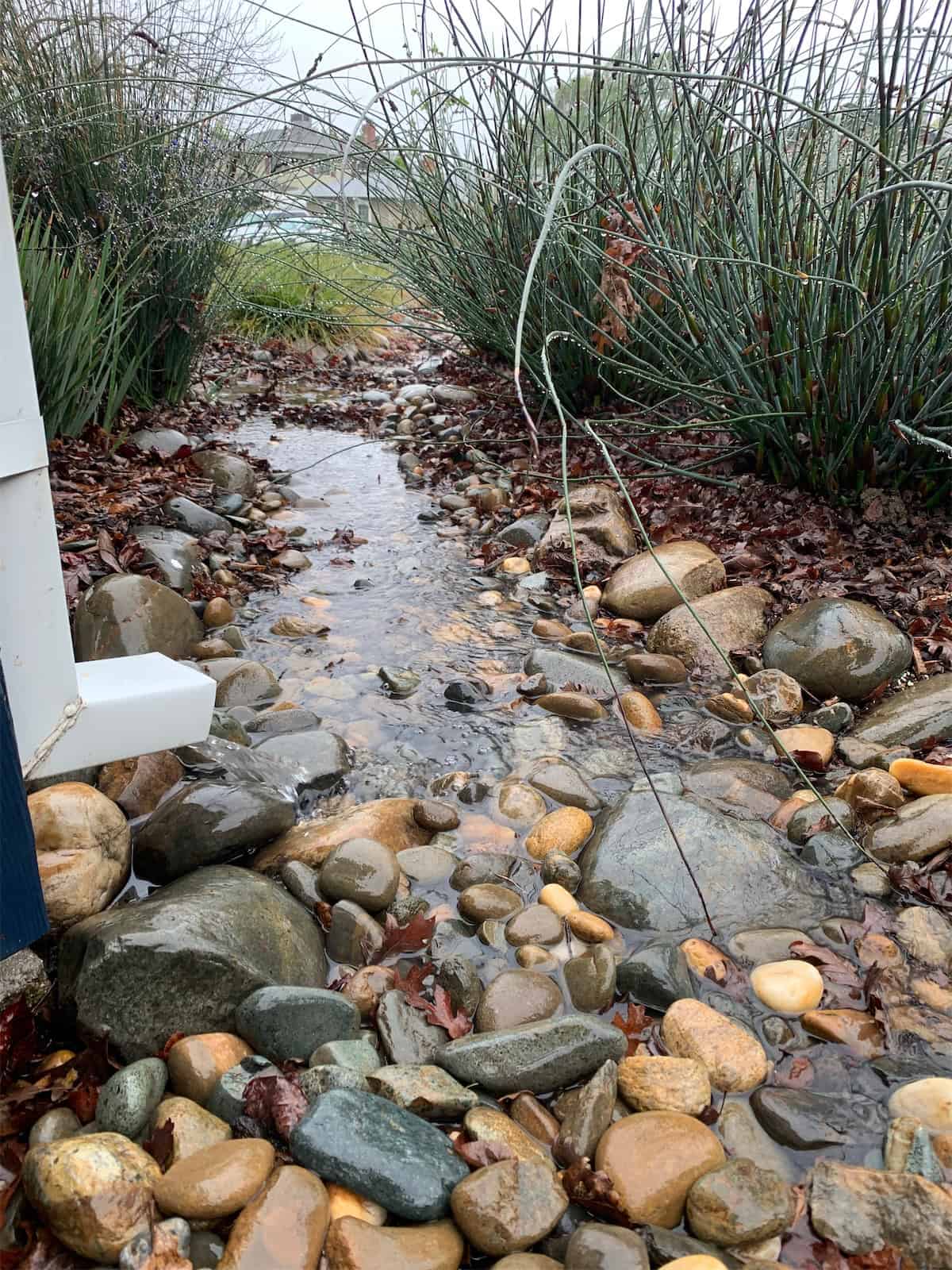
Roof runoff arrives fast and concentrated, so the first few feet below a downspout take the hardest hit. Line that landing zone with fist-sized river rock over a bed of smaller stone, and set one flat stone directly under the spout to absorb the impact.
From there, the runnel needs only a steady fall away from the house. Keep the channel narrow, about 18 inches wide, and carry it at least 5 feet from the foundation before letting it widen or turn.
Boulder Accents Along a River Rock Bend
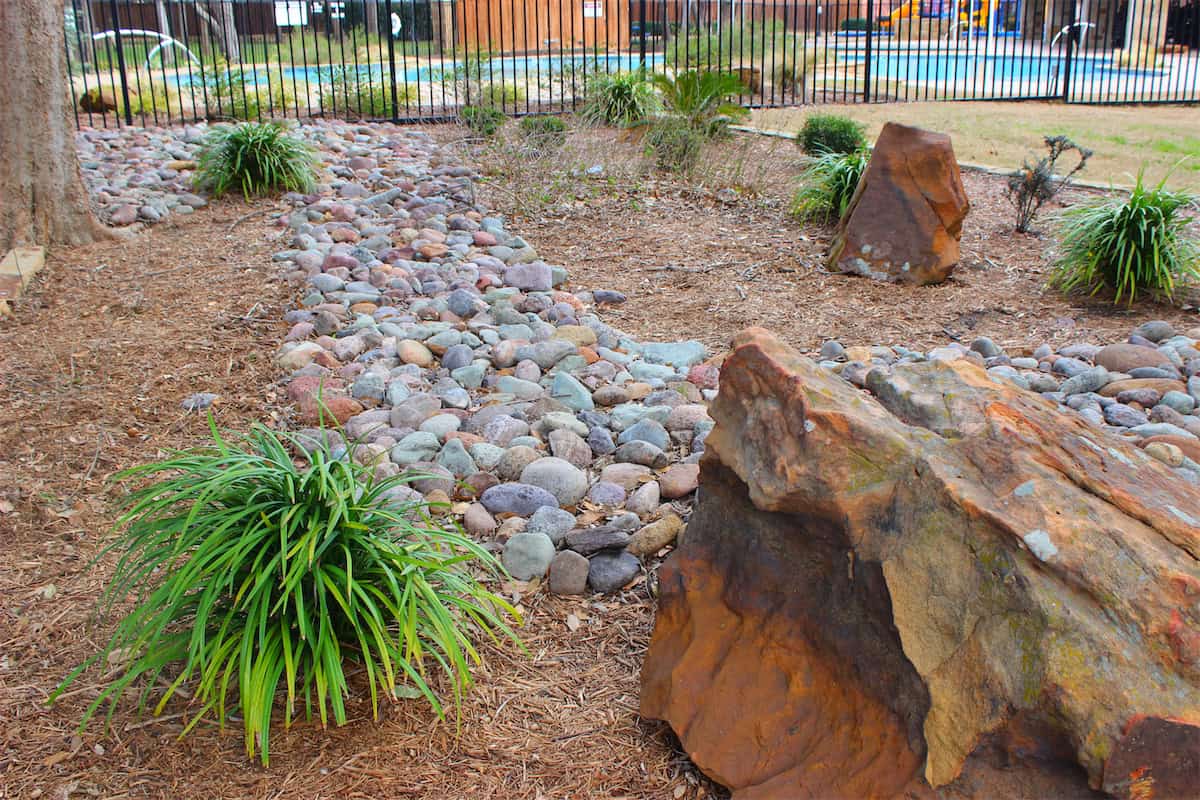
The outside of a curve takes the hardest push from water. That spot is where boulders belong, both for looks and to stop the bank from washing out.
Fine Gardening’s guidance places boulders at the start and midpoint of each curve. Bury each one a third of its height so it looks settled, and angle it slightly into the slope. Two-person boulders, about watermelon size, read as natural without overwhelming a residential bend.
Wooden Footbridge Over a Backyard Creek
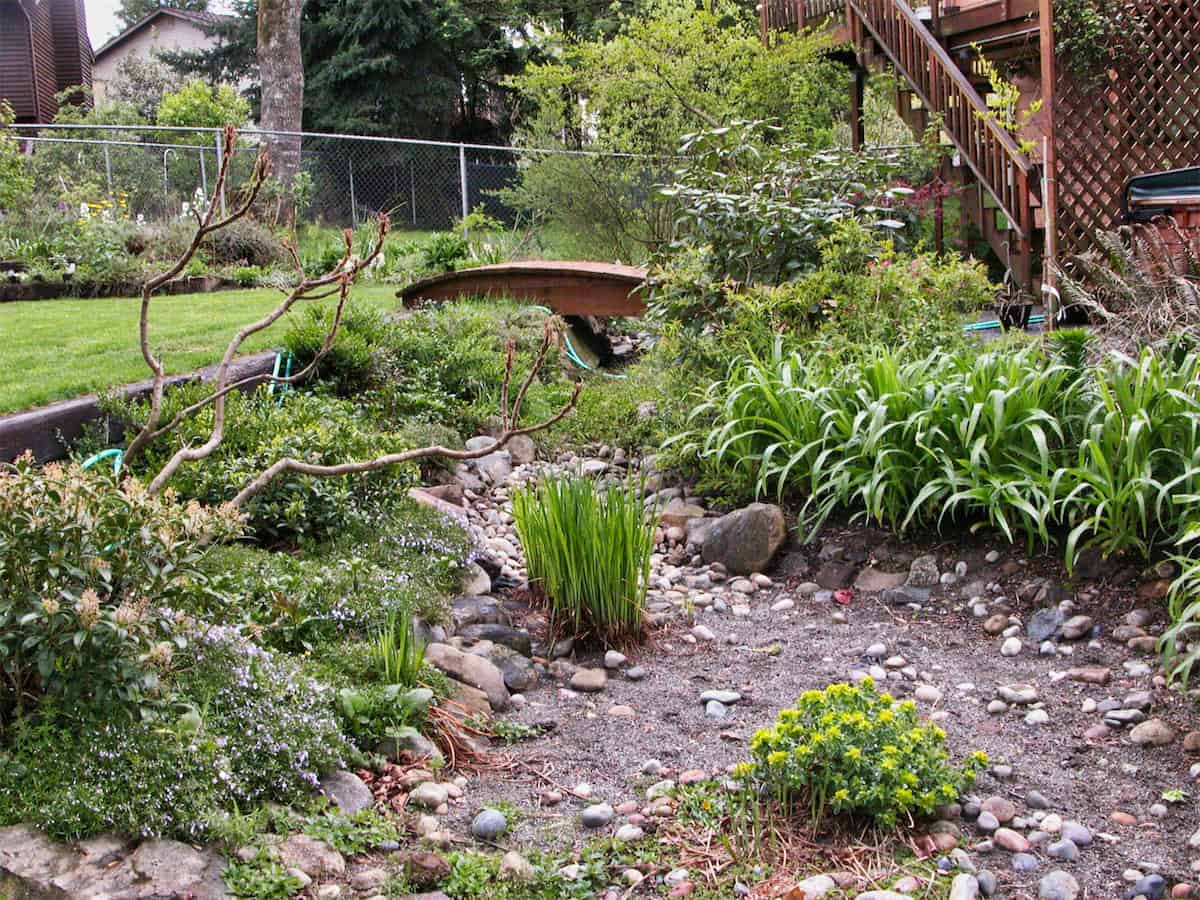
A footbridge turns the creek into a route through the garden. A simple span of cedar or pressure-treated planks on two stringers handles a narrow residential channel.
Rest the stringers on flat stones or concrete pads set beyond the bank on each side, never on the channel rocks themselves. Leave at least 6 inches of clearance above the high-water line so leaves and debris pass underneath during a storm.
Ornamental Grasses Softening the Banks
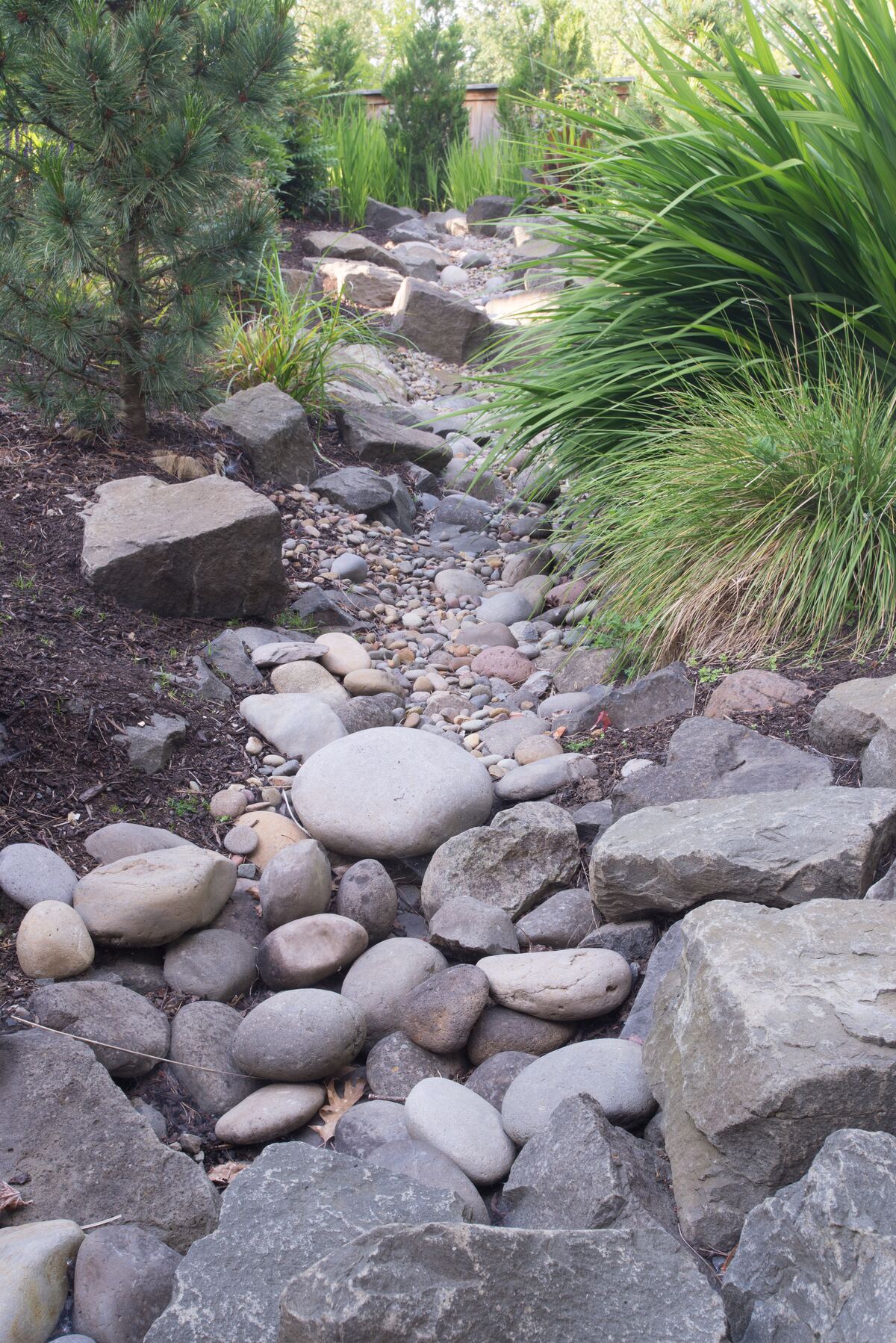
Grasses arch over hard rock edges and hide the line where stone meets soil. Little bluestem, prairie dropseed and fountain grass handle a soaking followed by weeks of dry weather.
Plant them in pockets between boulders, a foot or more above the main flow line, so their crowns sit clear of standing water. Space them at their mature width; a clump that looks lonely in May fills out by September.
Prairie Wildflowers Lining a Front Yard Creek
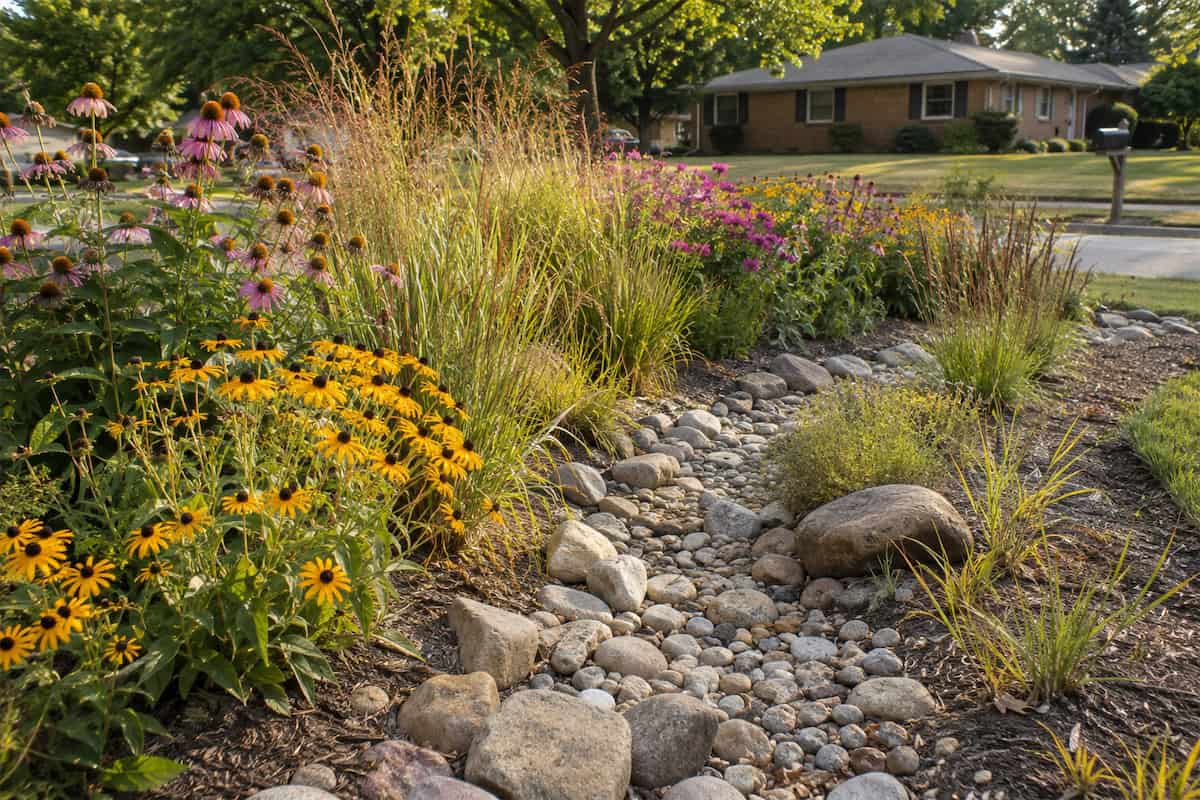
Native wildflowers turn a front yard creek into a pollinator strip, and their deep roots stabilize the banks. Coneflower, black-eyed Susan, blazing star and bee balm handle wet springs and dry summers.
Plant in drifts of five or seven of the same species for a strong look from the street. Keep the tallest plants to the back and shorter ones near the stones. Leave seed heads standing through winter for birds and visual structure.
Rust-Toned Boulder in a Wide Bend
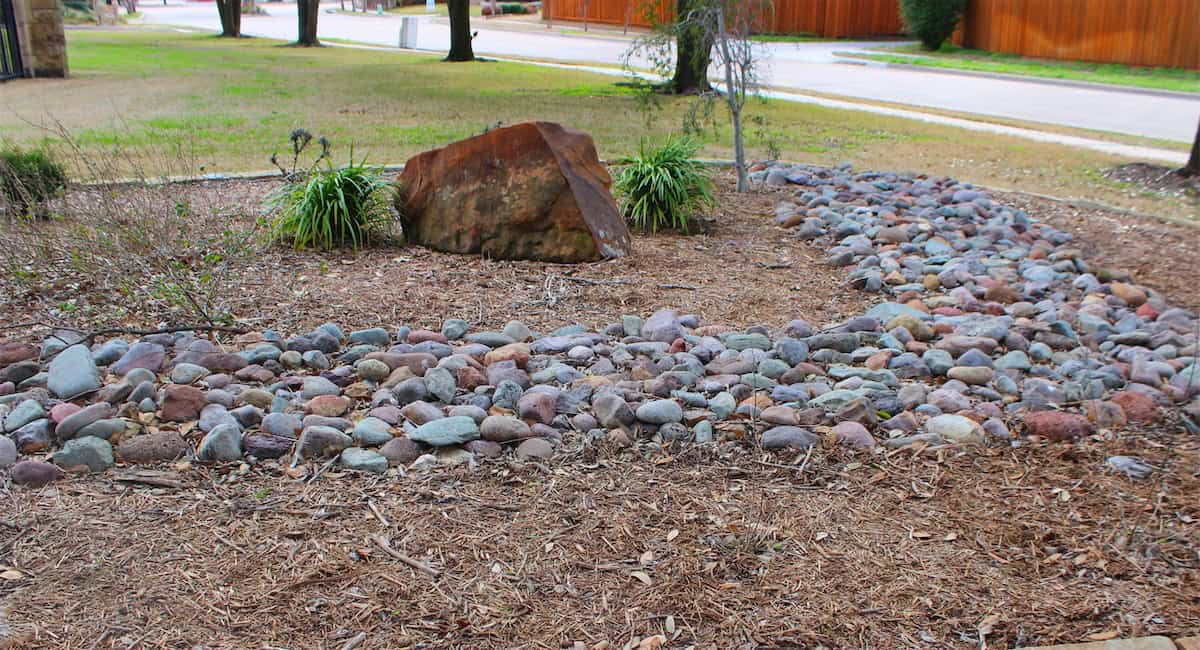
A large boulder with rusty, iron-stained surfaces stands out against gray river rock and anchors a wide curve. The color contrast catches attention from across the yard.
Choose a three- or four-person boulder and position it on the outside of the bend, where it doubles as erosion control. Bury about a third of its mass. Surround its base with smaller stones of the same rust tone to tie it visually to the rest of the creek.
Narrow Rock Swale Beside a Paver Path
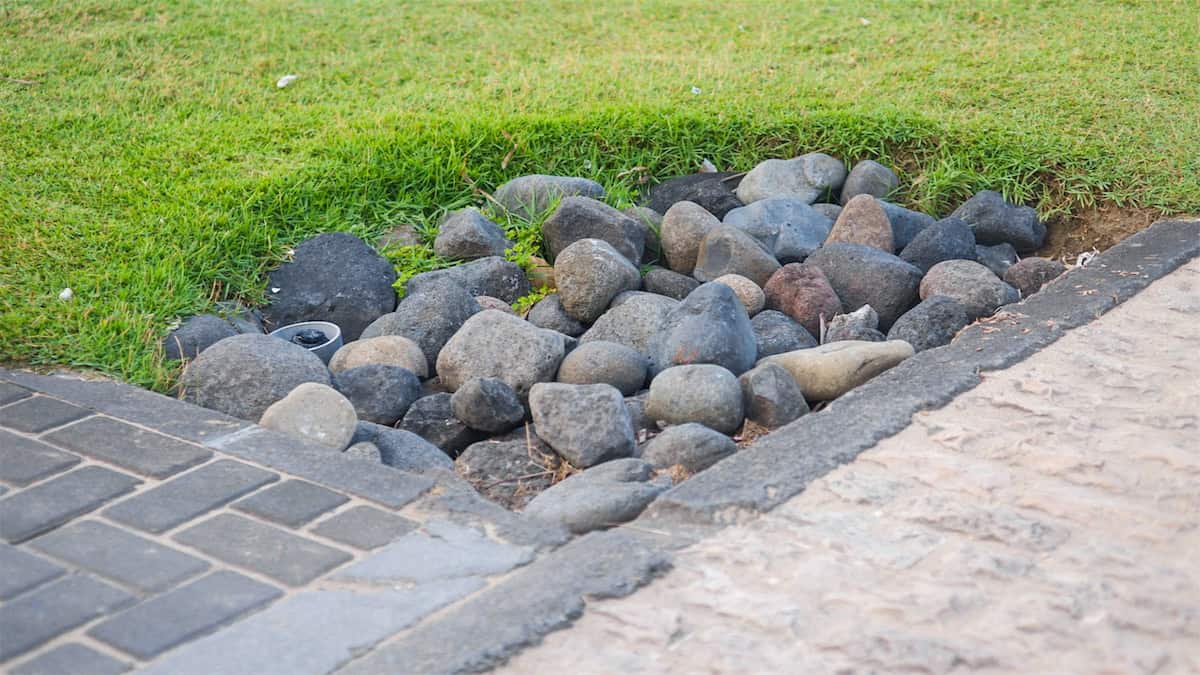
A paver path sheds water to its edges, and a narrow rock swale along one side catches that runoff before it soaks the lawn or puddles on the walk. The swale doubles as edging.
Keep it 12 to 18 inches wide and about 6 inches deep, filled with 1- to 3-inch river rock. Slope the path slightly toward the swale, and run the swale toward a lower spot in the yard or a rain garden.
Dry Creek Bed Along the Driveway Edge
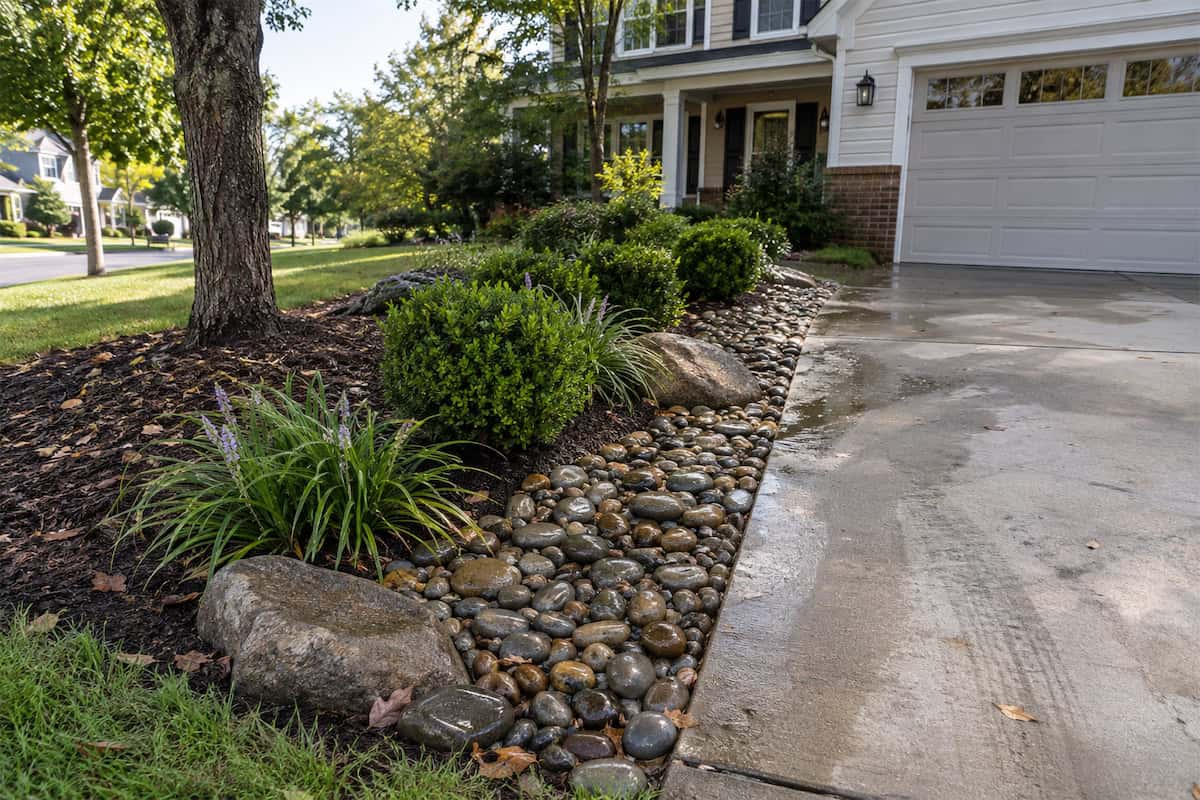
Driveways shed large amounts of water, and a rock channel along one edge collects and directs it away from the lawn and foundation. It also visually frames the drive.
Line the channel with larger 4- to 8-inch river rock near the pavement, where tires might roll over the edge. Set the rock just below the pavement edge so water spills in, and keep the digging clear of the gravel base under the driveway. Slope the channel toward the street or a dry well.
Cottage Creek Edged With Flowering Heather
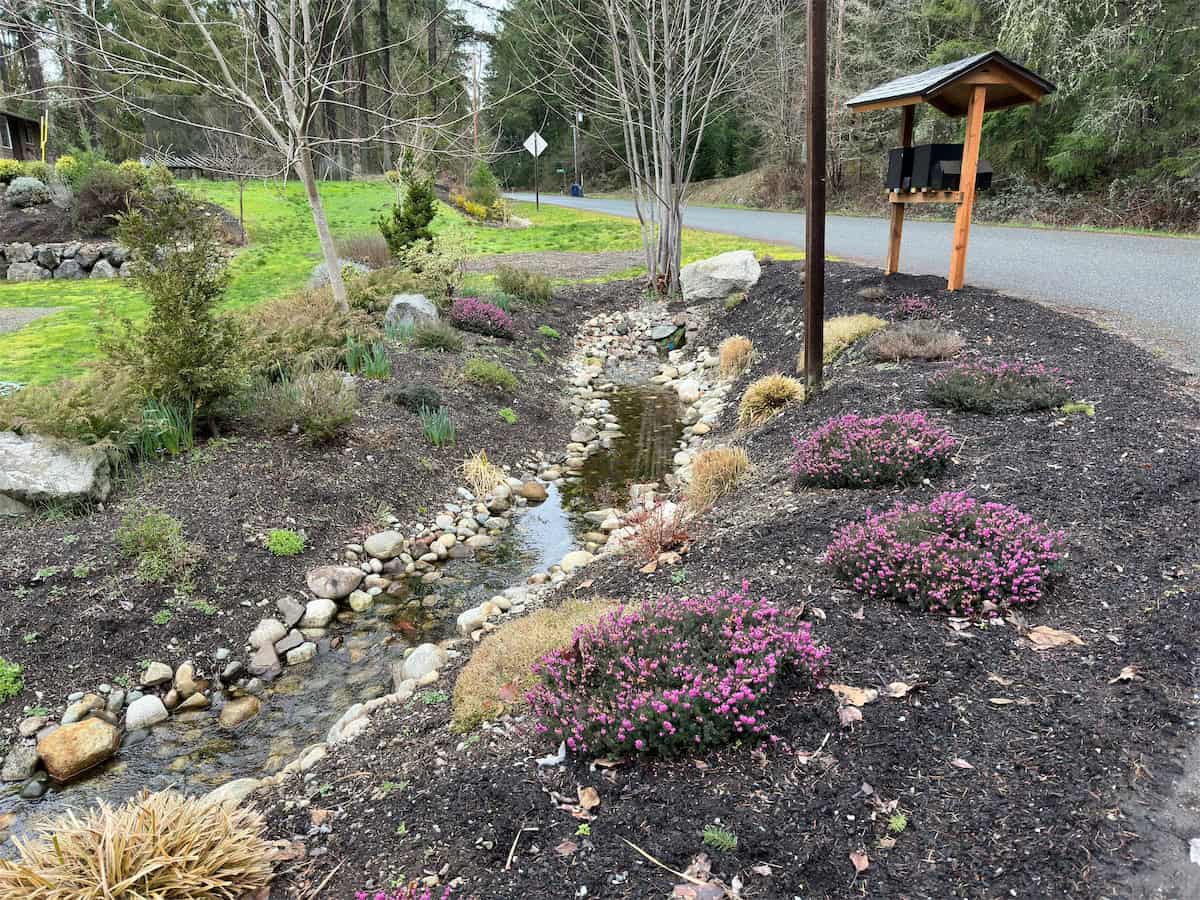
Heather forms soft, low mounds that drape over stones and blooms late summer into fall. Planted along a cottage-garden creek, it blurs the rock edges with color.
Heather prefers acidic, well-drained soil and full sun. Plant it above the high-water line in sandy or amended soil. Combine it with low-growing companions such as creeping phlox and lady’s mantle for a layered cottage edge.
Xeriscape Creek With Agave and Barrel Cactus
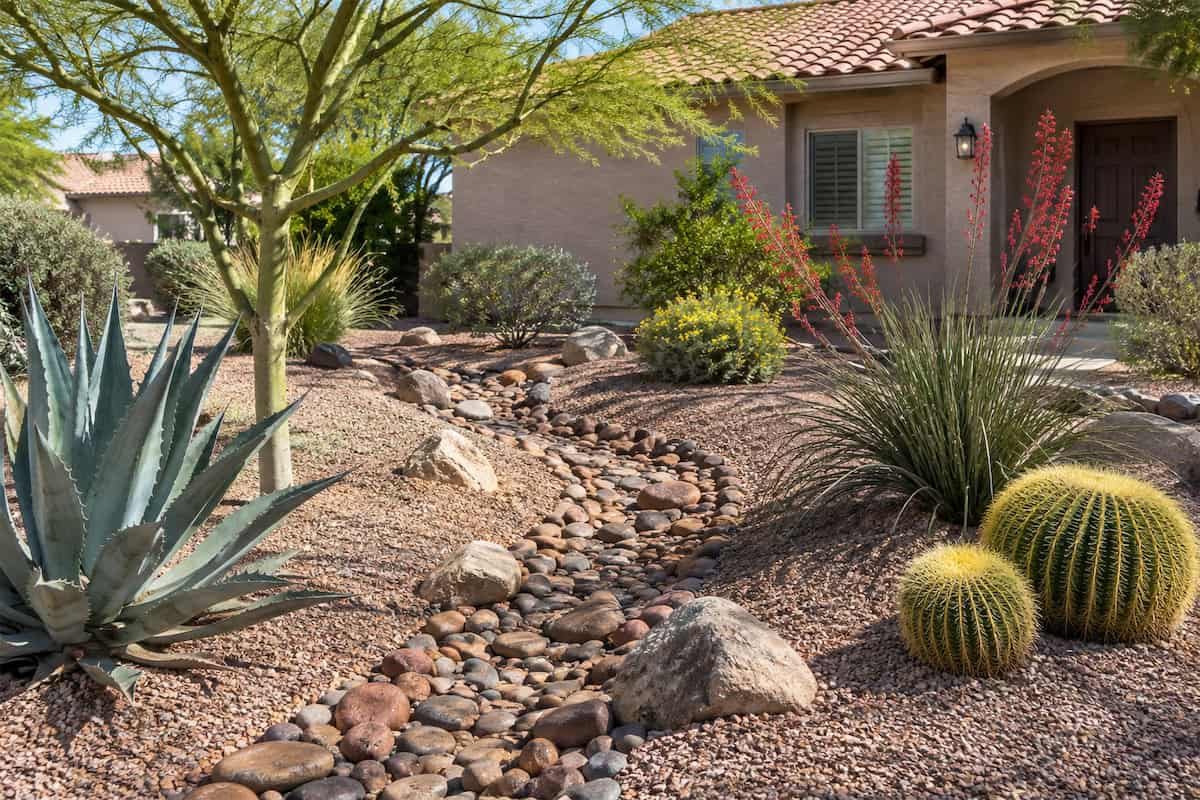
In dry climates, a xeriscape creek handles rare but intense storms. Agave and barrel cactus provide sculptural form with almost no supplemental water.
Plant succulents on raised banks, well away from the flow line, since they rot if their roots sit wet. Use decomposed granite or angular gravel for the channel and banks. Space agaves generously; many spread several feet across at maturity.
Large Cobble Splash Bed Against the Foundation
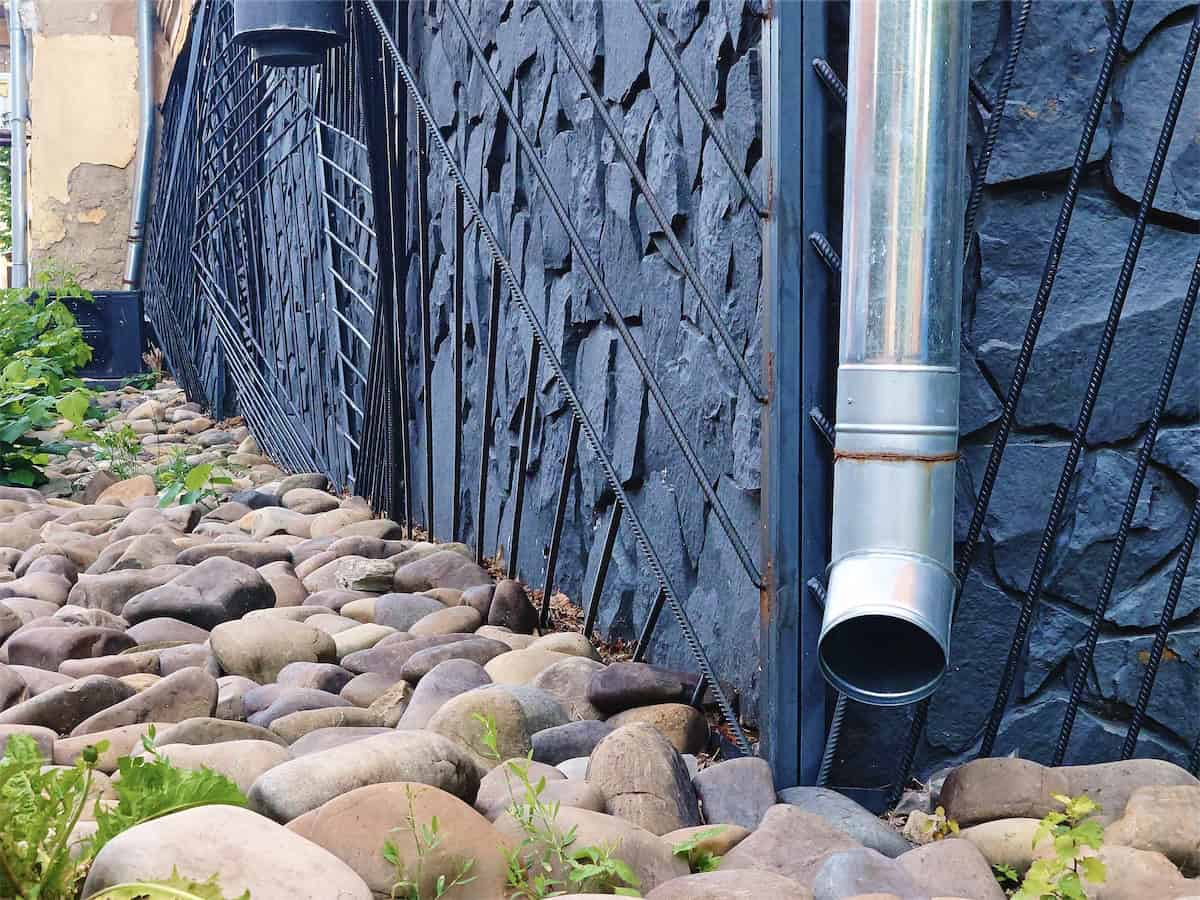
Right where a downspout or roof edge lets go, a splash bed of large cobbles keeps soil from spattering the siding and protects the ground beside the foundation from erosion.
Use 4- to 6-inch cobbles in a band about 2 feet wide. Grade the soil beneath so it slopes away from the house, then connect the band to a creek that carries water at least 5 feet out. Keep the cobbles below the siding and weep screed.
Strappy Perennials Along a River Rock Creek
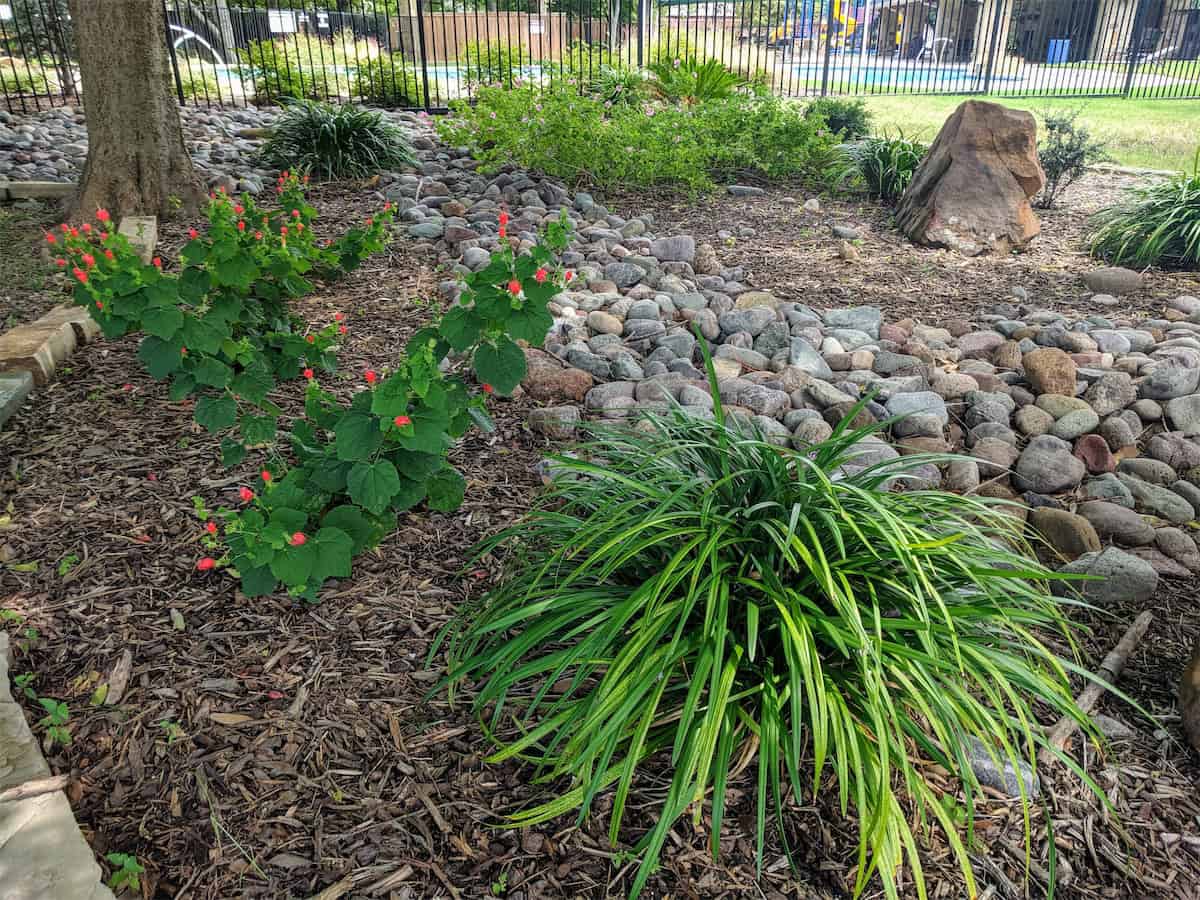
Daylilies, Siberian iris, liriope and blue flag iris have long, arching leaves that echo the flow of water. Planted along a creek, they make it look like a real streambed.
Siberian iris and blue flag iris handle the wettest spots. Daylilies and liriope prefer the drier upper banks. Plant in groups along the curves, and leave sections of bare stone for contrast.
Modern Linear Creek With Corten Steel Edging
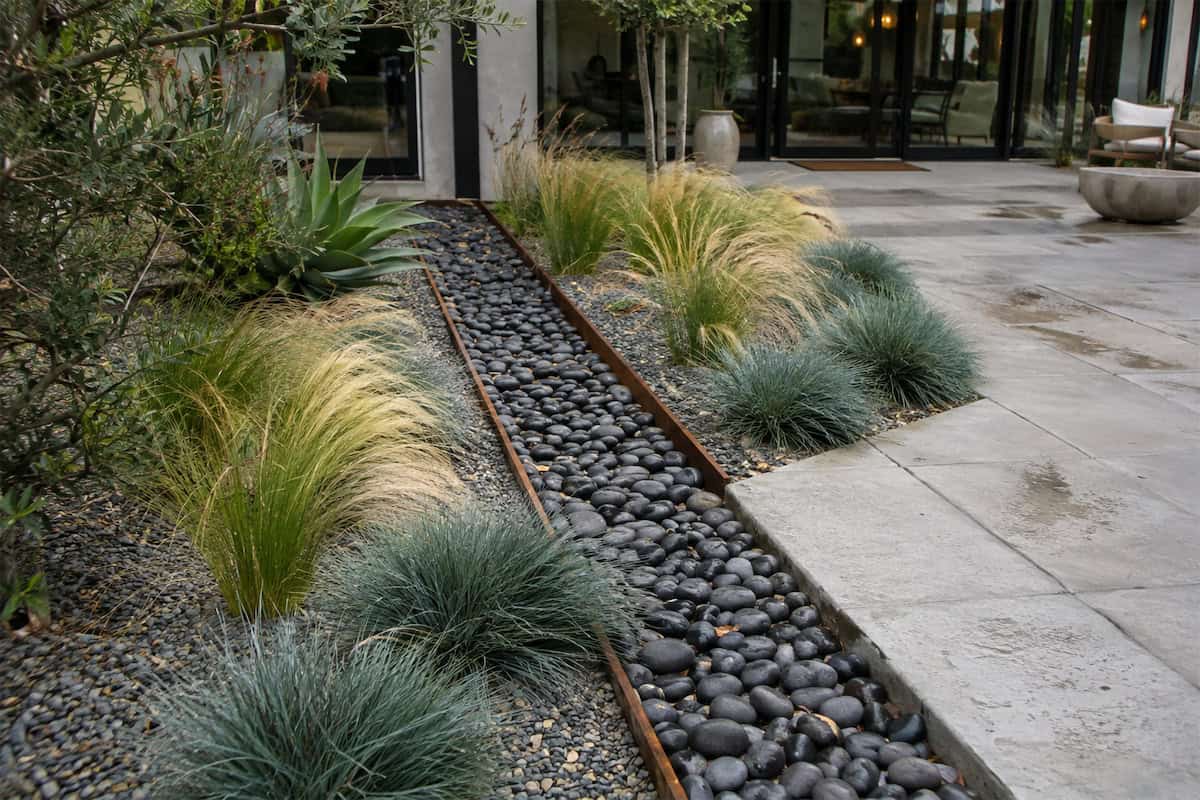
Corten steel weathers to a stable rust-orange patina that pairs well with dark gravel or pebbles. Straight-edged channels look architectural beside a modern home.
Use 1/4-inch-thick corten edging staked deep into the soil. Run the channel in straight lines or sharp angles, maintaining a steady downhill slope. Corten stains concrete as it weathers, so keep it away from light-colored paving or seal the edges.
Wide Boulder-Lined Creek Across an Open Lawn
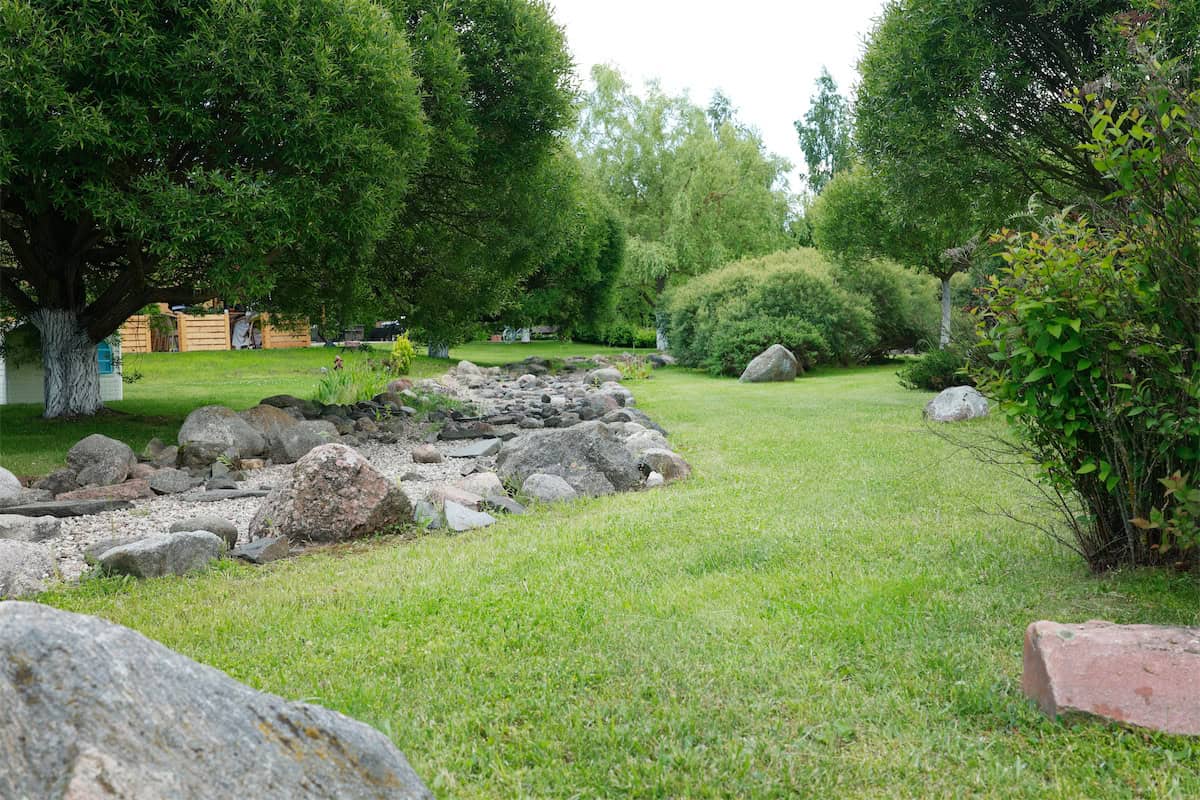
In a large, open lawn, a wide creek with boulders reads as a substantial landscape feature, not a drainage ditch. Its scale matches the space.
Keep the 2:1 width-to-depth proportion in mind, and dig only as deep as the runoff from the lawn demands; a broad, gently dished channel looks more natural here than a deep trench. Use a mix of rock sizes, with three- or four-person boulders at key points along the banks. Add a few native shrubs or trees nearby to integrate it with the yard.
Creeping Thyme Between the Edging Stones
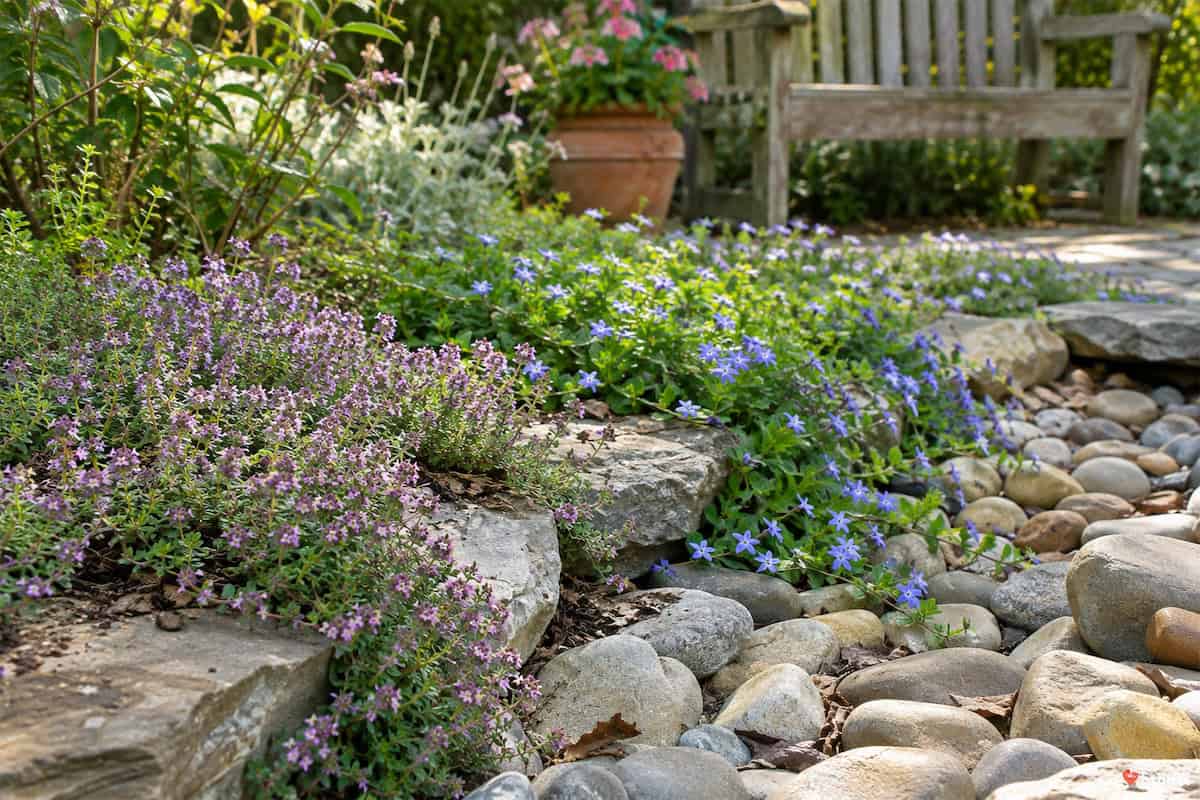
Creeping thyme fills gaps between stones with a low, fragrant mat that handles occasional foot traffic and blooms in summer. Planted along creek edges, it softens the stones.
Plant plugs in the gaps between edging stones, above the flow line. Thyme needs full sun and well-drained soil, so add gritty soil to the planting pockets. Water until established, then let it go mostly dry.
Stone-Lined Channel Through a Shady Lawn
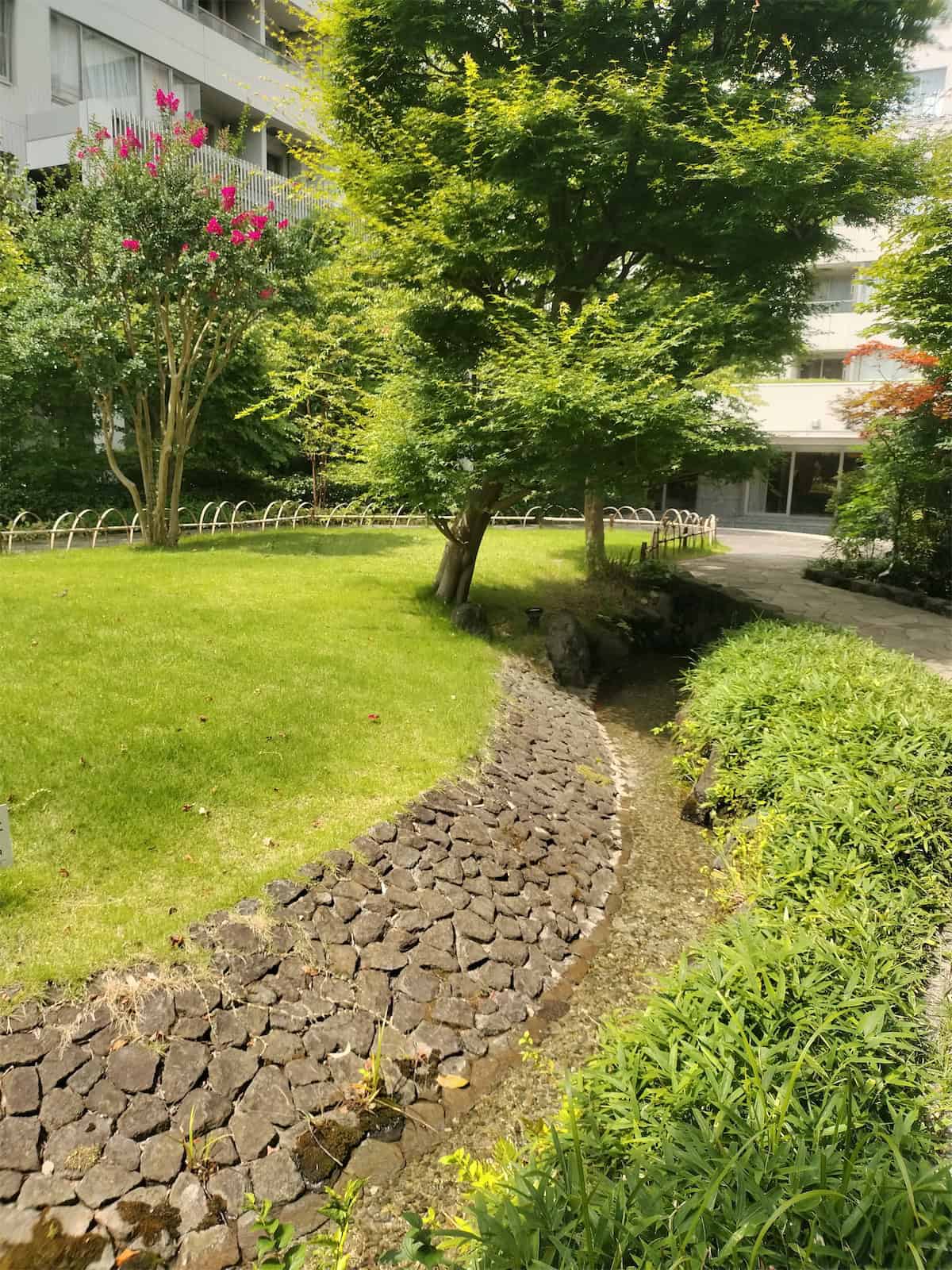
Grass struggles in deep shade, and a stone-lined channel replaces thin turf with a clean drainage feature. Shade-tolerant plants along the edges complete the look.
Use gray or dark stone to match the cool shade. Line the banks with shade lovers such as hellebores, Japanese painted ferns and hostas. Keep leaf litter clear of the channel in fall so water moves freely.
How to Plan a Dry Creek Bed That Actually Moves Water
Good drainage starts with grade. Follow the yard’s existing slope and keep a steady downhill fall along the channel bottom all the way to the outlet. Any flat or low spot holds water and breeds mosquitoes.
Before digging, call 811 to have underground utility lines marked. Then map where water comes from (downspouts, a neighbor’s slope, a driveway) and where it should go. Keep water on the property where possible, and send it toward a rain garden, dry well or street. The city public works department is the place to ask where excess water may legally go.
For proportion, a natural-looking creek is about twice as wide as it is deep, so a 4-foot-wide channel is about 2 feet deep. Use wide, gentle curves, since tight squiggles look artificial and slow water unevenly.
Layer the rock with smaller stones on the bottom and larger ones at the top edges. Place boulders at the start and midpoint of each curve. Fine Gardening recommends four rock sizes:
<table>
<thead><tr><th>Rock</th><th>Typical Size</th><th>Where It Goes</th></tr></thead>
<tbody>
<tr><td>Large boulders</td><td>3–4-person stones</td><td>Head of the creek and the biggest bends</td></tr>
<tr><td>Medium boulders</td><td>2-person stones, about basketball or watermelon size</td><td>Midpoints of curves and along the banks</td></tr>
<tr><td>Large river rock</td><td>5–8 inches</td><td>Upper edges and banks</td></tr>
<tr><td>Small river rock</td><td>3–5 inches</td><td>Channel bottom</td></tr>
</tbody>
</table>
Dry Creek Bed FAQs
How Deep and Wide Should a Dry Creek Bed Be?
A dry creek bed should be about twice as wide as it is deep. A 4-foot-wide channel is roughly 2 feet deep, and a narrow 2-foot swale is about 1 foot deep. Size the channel to the volume of runoff it handles, and keep a steady downhill slope along the bottom.
Do You Need Landscape Fabric Under a Dry Creek Bed?
No, landscape fabric is optional. In clay soil, rocks are set directly into the soil. Loamy or sandy soil benefits from fabric to keep soil from washing into the channel. Fabric does not stop weeds, since debris collects on top of it and seeds germinate there.
How Far From the House Should Downspout Water Go?
Downspouts should discharge at least 5 feet from the foundation, according to the U.S. DOE Building America Solution Center. If water goes to an underground system, that system should be at least 10 feet from the house. A dry creek bed carries water well past these minimums.
What Size Rock Works Best for a Dry Creek Bed?
A mix of sizes looks most natural and drains best. Use small river rock (3–5 inches) on the bottom and large river rock (5–8 inches) toward the top edges. Place two-person to four-person boulders at the start and along curves. Mexican beach pebbles look best in modern, tailored strips.